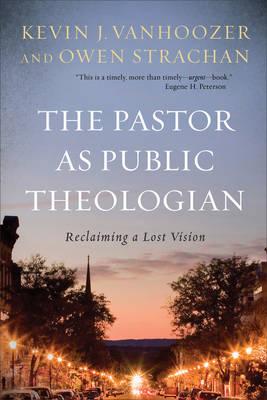
I feel these things deeply as well. When I was involved in making faculty appointments in the ‘academy’, finding people who kept feeling this pull to the pastorate was high on the list of criteria. And now, twenty-six years since I left pastoral ministry, reading Vanhoozer & Strachan’s The Pastor as Public Theologian has played its part in keeping that gravitational force alive in me. It is likely to be one of the books of 2016 for me…
The authors wade into the contemporary confusion surrounding the imagery used to describe the pastor – ‘the pictures that hold us captive’ (7) – looking to ‘reclaim a lost vision’ as they do so. You know them as well as I do. CEO. Therapist. Manager. Coach. Etc. Pastor and church and seminary must all bear some of the blame for the confusion. ‘The way forward is for pastors and theologians to bear one another’s burdens, responding together both to the ecclesial amnesia of the academy and to the theological anemia in the church’ (7).
Chapter One places the pastor-theologian within a biblical framework. Chapter Two is historical in its focus, while Chapter Three and Four capture the perspectives of systematic theology and practical theology. After each chapter, people offer short ‘pastoral perspectives’. Then, after all the chapters, there are fifty five ‘summary theses’ (183-188) which capture the essence of the book.
So, for me, where are the purple patches in the book?

1. My default setting with the biblical imagery of the pastor has always settled with 5xSs (shepherd, servant, steward, seer, sage) and 1xP (parent). In addition to this, there are deep convictions about good governance being about prophet-priest-king. Here, in this ‘biblical theology of the pastorate’ (OS, 37-60), we are called again to the ‘prophet-priest-king’ triumvirate – first in the OT, then in Jesus, and finally in the pastor: ‘ministering grace (priest), ministering wisdom (king), ministering truth (prophet)’.
To a people besieged by Satan and pulled away from God by sinful temptation, the pastor acts as priest, calling them to freshly partake of God’s grace, which overcomes sin and creates a new way of life, salvation life. To a people who desperately need wisdom in a world order built on powerful lies, the pastor acts as king, training the people’s eyes on the humility and meekness of Jesus Christ, who by his death overcame the enemy and destroyed the forces of darkness, a victory veiled from the natural man but gloriously visible to the eyes of faith. To a people who crave reliable words in a culture of unstable images, the pastor acts as prophet, delving into all the Scripture to exposit Christ and call the people to fresh repentance and reinvigorated faith … Today, as in ancient times, pastors act as theologians of the church, shining into yearning hearts ‘the light of the knowledge of the glory of God in the face of Jesus Christ’ (2 Cor 4.6). (OS, 59-60, emphasis mine).
2. I’ve never thought before about the ‘many moods of theology’ (KV, 104). Society has its moods, be it an anxiety, a despair, or an acedia, ‘a kind of existential listlessness, torpor, or stupor’ (106). But theology also has its moods, which the pastor-theologian needs to embody. Vanhoozer mentions three, in particular:
+ Interrogative: ‘is the window open?’ – expressing ‘a lack of certainty about a state of affairs’ (108).
+ Imperative: ‘shut the window’ – expressing ‘a desire to have the world conform to one’s language’ (108).
+ Indicative: ‘the window is open’ – expressing ‘one’s belief that the world is a certain way’ (108).
‘The gospel is in the indicative’ (108) … and the pastor-theologian is ‘a minister of this reality … (in order) to indicate what is in Christ’ (109). But this ‘gospel indicative contains a tacit imperative, a demand actively to conform to what is and joyfully participate in what is.’ (KV, 120)
What are theologians for? What is the distinct service of the pastor-theologian? … The real work of theology is public: growing persons, cultivating a people. It is about helping individuals and communities to grow into the fullness of Christ. In sum: the real work of theology is the work of getting real – conforming people’s speech, thoughts, and actions to the mind and heart of Jesus Christ, the source and standard of all truth, goodness and beauty (KV, 125).
3. It is fascinating to consider Stottian ‘double listening’ from a different perspective: biblical literacy and cultural literacy (KV, 112-120). ‘A theologian is a minister of understanding … (helping) people make connections’ (112) between these two ‘literacies’. In terms of biblical literacy, (noting that the same base Greek word is behind Acts 6.2 and Acts 6.4),
it is surely significant that Luke uses the same term for serving tables as he does for serving God’s word. Theologians wait tables, serving the Word to others so that they can more easily digest it (KV, 113).
With cultural literacy, we are recognising culture to be ‘a society’s software, a program for cultivating humanity and shaping its freedom’ (116). It ‘refers to what Christians need to know about their everyday culture in order to be effective cultural agents for Christ’s kingdom’ (117).
The most important task of the pastor-theologian is to ensure that the congregation wakes up and stays awake, becoming aware of culture and what it is trying to cultivate in our hearts and minds (KV, 117).
He uses the example of moralistic therapeutic deism (the MTD virus, or what Vanhoozer refers to as a ‘socially-transmitted disease’ (116)). Vanhoozer also adds the importance of ‘human literacy’ by which he means growing in knowledge and understanding of people, by being among them – but he also makes a case for achieving this by reading the best fiction.
4. Another ‘purple patch’ for me is where Vanhoozer asks, ‘What are seminaries for?’ (KV, 125-129). He writes about the need to transcend the ‘theological apartheid’ that separates biblical studies, systematic theology, and practical theology.
All those years ago, I graduated from TEDS (Deerfield, Ill) with a compartmentalised mind. I was grateful to God for eight years teaching at the Bible College of New Zealand (now, Laidlaw College) during which I taught in every department and at every level (diploma, degree, masters). This helped break down the ‘theological apartheid’ and helped make me a generalist. Then when I went across to Carey Baptist College, we developed a Thematic Integrative Seminar as the capstone of the degree – specifically designed to subvert this ‘apartheid’ (following a similar approach to Vanhoozer’s Everyday Theology – but, I might add – developed before he published his book!), as we sought to enable students to think in an integrative, generalised and missional manner.
The seminary needs to feel this pressure. Finding what it is that ‘integrates the seminary or, more pointedly, what (it is that) gives the seminary integrity’ (128) is critical. It needs to produce ‘the kind of generalist who thinks about everything in life in relation to its summation in Christ (Eph 1.9-10)’ (128).
The point of seminary curricular integration should therefore be pastoral wisdom, which demands literacy, competency, and excellence alike. By literacy, I mean everything pastors need to know in order to carry out their vocation of becoming a shepherd like Christ. By competence, I mean capacities a pastor must acquire in order to do ministry effectively and put literacy to good use; pastor-theologians must be generalists not only as pertains to knowledge but also to skills. By excellence, I mean all the personal qualities a pastor needs to have in order to be one who rightly ministers Christ – the way, the truth, the life – to others. (KV, 129).
5. I am always keen for some new imagery of the church that captures a fresh perspective on biblical truth. How about ‘an eschatological embassy’ (KV, 141)? Love it. Afterall, an embassy is ‘an institution that represents one nation [ie the kingdom of God] inside another nation’ (141, quoting Leeman).
6. One final ‘purple patch’ with insights into the ministry of preaching (KV, 156-161).
What sets Christian preaching apart from every other form of human communication is its participation in what is ultimately a triune activity: preaching is distinguished by its authoritative source (Scripture, the Word of God), unique content (gospel, what is Christ), and unique persuasive power (illumination, the work of the Spirit) (157).
Vanhoozer gives four reasons why ‘the sermon is the cutting edge of public theology’.
a. ‘Preaching fosters biblical literacy, biblical-theological competence, and canon sense’ (157).
b. ‘Preaching fosters theological literacy, the ability to read and critique our world – our history, our culture – in the light of God’s presence and activity’ (157).
Here is where we are warned, yet again, of becoming too obsessive about wanting to appear to be relevant as we preach, lest we bend over so far that we fall in.
In expositing God’s word, pastor-theologians give their congregations a powerful means to discern, and then cast down, the idols of our time … pastors are never more prophetic than when they call people to stop pursuing false idols (e.g., fame, wealth, physical beauty, social status, popularity, career, self-actualization, etc.) and return to serving the living God (158).
c. ‘Preaching wakes up the local church, here and now, to the bracing reality of Jesus Christ, who is always and everywhere at hand and yet beyond our grasp’ (159).
The sermon is thus a word full of grace and truth that takes subevangelical thought captive, exposing the emptiness of other narratives and false gospels that seek to colonize our imaginations … the sermon is the gospel’s Western Front, as it were, the cutting edge of the word’s forward progress as it conquers new territory, one heart at a time (159).
d. ‘Preaching draws the local church, here and now, into relationship with the bracing reality of Jesus Christ, directing disciples to adopt beliefs, values, and practices that correspond to what is in Christ in order to get real’ (160).
Preaching inscribes the gospel on listening hearts and inserts listeners into the story … through preaching God’s Word, (preachers) minister reality to people, helping people to act in ways that correspond to what is in Christ, and hence to get real (160, 161).
“Well, when you describe it like this, Drs Vanhooser & Strachan, it wouldn’t take much for me to join Dr Carson and feel that sense of being drawn back into pastoral ministry.”
nice chatting
Paul
About Me

the art of unpacking
After a childhood in India, a theological training in the USA and a pastoral ministry in Southland (New Zealand), I spent twenty years in theological education in New Zealand — first at Laidlaw College and then at Carey Baptist College, where I served as principal. In 2009 I began working with Langham Partnership and since 2013 I have been the Programme Director (Langham Preaching). Through it all I've cherished the experience of the 'gracious hand of God upon me' and I've relished the opportunity to 'unpack', or exegete, all that I encounter in my walk through life with Jesus.
Recent Posts

Football helps me train preachers. See, when you speak to me about football—or, ‘footie’—I need to know where your feet are before I can understand what you mean. Are your feet in Ireland, or Brazil, or the USA, or NZ—or in crazy Australia? It must be the most fanatical sporting nation in the world. Within…
Having been born in 1959, I don’t remember much about the 1960s. But I have heard a lot. Hippies. Drugs. Rock ‘n Roll. Assassinations. Moon-walking. A quick trip across to ChatGPT informs me immediately that it was ‘a transformative decade across the world’—marked by the civil rights and feminist movements, Cold War tensions, consumerism and…