Exactly forty years ago, I did not fully appreciate what was up ahead of me…
I had been accepted for MDiv studies at Trinity Evangelical Divinity School (TEDS), near Chicago. All I really knew was that it would start with ‘Suicide Greek’ — learning the language over six days a week for six weeks, under the tutelage of DA Carson, with Tony Plews as his Teaching Assistant. Then, for the following 12 months, I was to find myself in one ‘biblical exegesis’ class after another. New Testament Greek Exegesis. Old Testament Hebrew Exegesis. Recently, I rediscovered a box of the assignments from these classes. The theory was drilled into us and then we had ample opportunity to practice.
I loved it. I even took an Advanced Greek Grammar class. The work of my peers ended up in the first edition of Carson’s
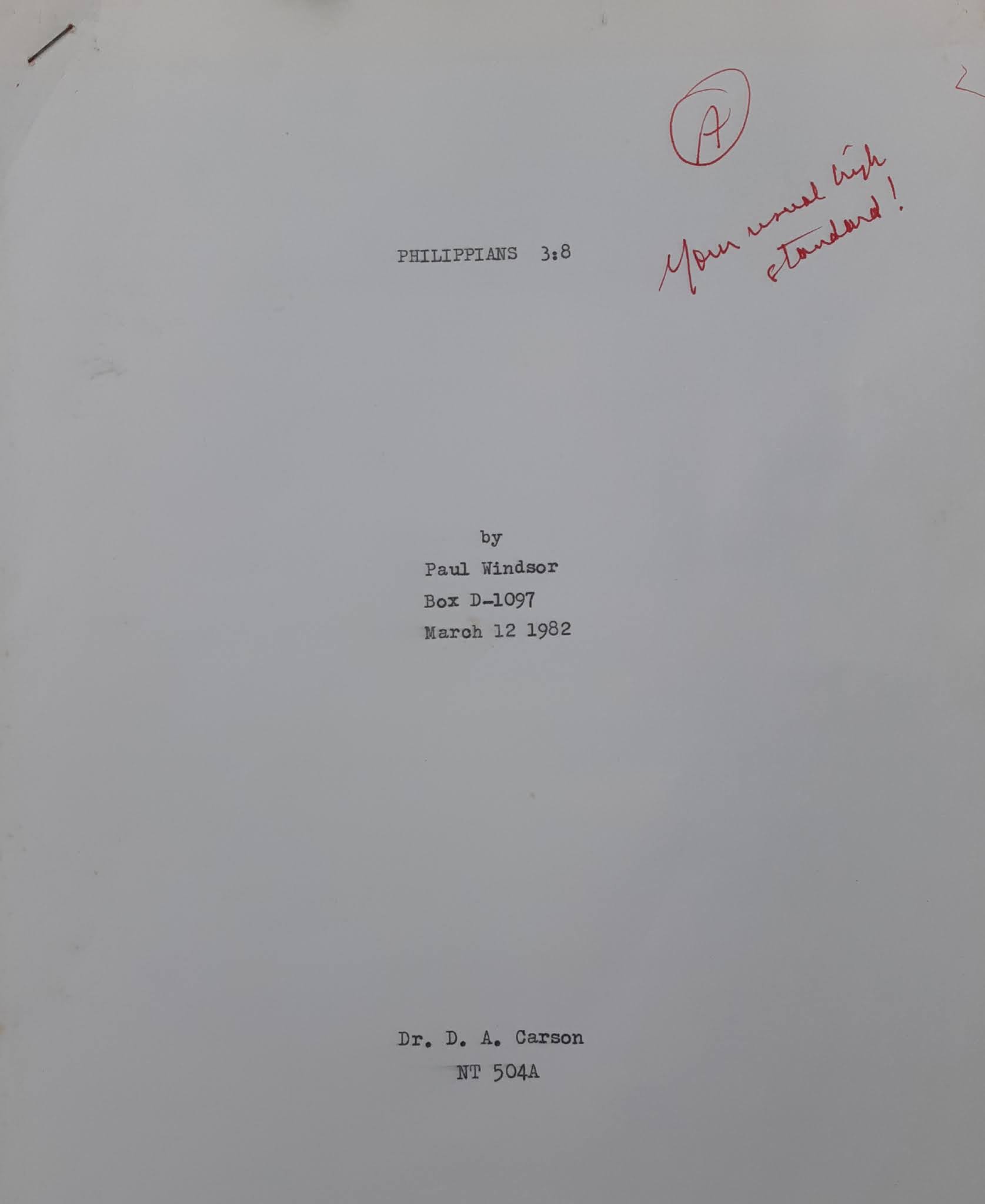
Exegetical Fallacies book — but not mine. The fateful words on the front page of my returned assignment still haunt me: “Because you went first, B+” — which, when the intention of the author is considered, probably meant a C+. And when the response of this reader is considered, let me tell you, it felt like an F. It really did. I can’t find that front page (it must be in India, where I must have used it to cheer up my students!) and so I’ll add another front page here, one that cheers me…
To exegete a text is just a fancy word for unpacking the text, on the way to discovering its meaning. Back in the early 1980s, this exercise was primarily a combination of discovering the intention of the author and the meaning of the words they use — with historical and literary contexts playing a massive role. However, in the intervening years, a third aspect has surfaced from the philosophical depths swirling below for decades: the response in the reader. Fair enough. What we see in the text is shaped by what we bring to the text. The meaning of a text is conditioned by two contexts, both the author’s and the reader’s. There is a more dialogue going on than we realize, not just dissection.
And so, with exegesis, we look behind the text to what the author intended; we look within the text to what the text actually says; and we look in front of the text to how the reader responds to it. It was in the 1990s, when I embarked on some work on the parables, that all this began to dawn on me. I discovered that interpreting the parables becomes a bit like the tiny, taut, triangular trampoline that used to live at the foot of my parent’s bed. The parable is like the mat. The springs are attached to the three sides, representing these three approaches, with each of these approaches playing with the other to create a bouncy dynamic in the meaning of the parable — but then each of the three constrains the excesses of the others as well.
I think it was Craig Blomberg who wrote about a ‘principled eclecticism’ in biblical interpretation. I like it. Afterall when the ‘reader’ runs the show alone, it can be hard for the reader to hear anything hard in the text. They keep hearing the soothing echoes of what they already believe. But, let’s be fair here, when the ‘author/text’ runs the show, we can be stuck with interpretations handed down the generations, making it difficult to hear anything fresh in the text.
Interestingly, these principles are not just useful for interpreting biblical texts. For example, for years I’ve thought that the covenantal text that is the founding document of Aotearoa-New Zealand, the Treaty of Waitangi, could be placed helpfully in this trampoline.
Sadly, with the postmodern ‘turn’ through which we have been passing, focus in meaning-discovery has shifted across, decisively, to the reader. At its extreme, “the author must die if the text is to live and the reader liberated” (Vanhoozer). Consider the English curriculum in our schools. The authors of ancient texts appear dusty and musty. The purpose now is more to see how well students can express their response to such texts, if they are still used at all. Or, consider the History curriculum. Authors with their texts tend to be seen as instruments of power, rather than truth, and where this has led to abuse of such power — as with colonization, patriarchy etc — then meaningful history can only happen where there are revisions to that history. Fair enough, to a degree.
However, I remain unconvinced about the author ‘dying’ when it comes to biblical exegesis. And yet, isn’t that what often happens in what passes as ‘small group Bible study’ today? Read the passage. Go around the circle with questions like “What do you get from this passage?” or, “What does this passage mean for you?” Out flows the sharing. Every person’s viewpoint is affirmed. No one is told that they are wrong. A jumble of interpretations are heaped up in the middle of the room, often mutually contradictory, but no one seems to mind. The author is forgotten. “We’ve had our Bible study”. Yikes. That cannot be right. The Bible cannot be infinitely malleable with its interpretation…
With biblical exegesis, the human author with their text, inspired by the divine author, needs far greater prominence. The trampoline has its limitations. Today, is there still
a heart for engaging the biblical author and their text in a sustained, disciplined and comprehensive manner? Hmmmm — not sure. To this day, even in a preaching class, I have to offer some rehabilitative biblical exegesis. I tend to give samples of it being done well and have students observe what they see. So more practice, than theory. Overhear it, rather than do it. Otherwise my preaching class turns into an exegesis class!
For years, I’ve used Grant Osborne’s The Hermeneutical Spiral and the two exegesis samples he includes within its pages, one from Zephaniah and one from Ephesians. But earlier this month, my friend, Mark Grace, gave me a superb little 27 page book. 27 pages. Somehow I missed it when it was published in 2015: Murray J. Harris, John 3.16. What’s It All About. Exegesis at its very best. It is brilliant. The author is a New Zealander, living now in Cambridge (the NZ version, not the UK one!), and is one of the world’s finest biblical exegetes. He was instrumental in me going to TEDS all those years ago, a story I narrate in my review of his lovely little autobiography, Before I Forget. I feel an assignment/exercise coming on, an occupational hazard for teachers: Read this book and then describe what accurate, effective biblical exegesis involves.
nice chatting
Paul
In the week of the centenary of his birth, a relatively unheralded quotation from John Stott that has helped me so much with my exegesis comes to mind:
The real hallmark of the evangelical is not only a present submission to what (s)he believes the scripture teaches, it is a prior commitment to be submissive to what we may subsequently learn to be the teaching of scripture, whatever (it is that) scripture may be found to teach.