Kuruvilla has a science background, as a trained (and still practicing, as I understand it) dermatologist. It comes through in his writing. It is a tidy book, the product of an ordered and logical mind. Goodness me, at times it even appears that each chapter might well have exactly the same ‘word count’! This tidy-ness is evident in the Table in which the book is summarised (10). In the left column is Kuruvilla’s description of preaching, phrase by phrase, and then in the right column are the titles of his chapters, with each chapter handling a successive phrase.
| Vision for Preaching (ie his definition) | Chapters in the Book |
| Biblical preaching, | 1. Preaching is Biblical |
| by a leader of the church, | 2. Preaching is Pastoral |
| in a gathering of Christians for worship, | 3. Preaching is Ecclesial |
| is the communication of the thrust of a pericope of Scripture | 4. Preaching is Communicational |
| discerned by theological exegesis, | 5. Preaching is Theological |
| and of its application to that specific body of believers, | 6. Preaching is Applicational |
| that they may be conformed to the image of Christ, | 7. Preaching is Conformational |
| for the glory of God | 8. Preaching is Doxological |
| – all in the power of the Spirit. | 9. Preaching is Spiritual |
I know a few people who will groan at the sight of this neatness. It looks more like opening the door into a hotel room than it does opening the door into a teenager’s bedroom, which might be a simplistic way to picture the difference between a modern framework and a postmodern one! But don’t let this fool you too much. Kuruvilla writes well, very well, with ample imagery and analogy. On this scientific template he does paint a lot of art and, overall, this is the most satisfying part of reading the book. I love it like this.
Kuruvilla’s main concern is with the journey from biblical text to final sermon, or, using the bigger words, how hermeneutics shapes our homiletics. He argues that ‘this complex – and critical – issue of how the preacher moves from text to sermon has not been explicated; thoughout church history it has remained something of a black box’ (6). Maybe that assertion is a little extreme, but I am more than happy for him to make his case.
There are a number of places in this book to which I will return and so in order to help me not to forget them (and grateful, ever so grateful, for the ‘search’ function on this blog to assist with those future visits!), let me cover a few of them here:
1. As an alternative to the more common practice of topical preaching, he makes a case for
lectio continua, preaching through the Bible, passage by passage (23-25). This ought to be the ‘staple (and stable) practice of preachers’ (25). While I agree, I am actually itching to do some topical preaching myself, but only the brand which follows the biblical-theological trajectory of a topic – like what
J. Daniel Hays does with the topic of race. We need this kind of topical preaching, quite desperately methinks.
2. I am often tempted to teach a course on preaching which follows Aristotle’s triad of logos-pathos-ethos. It covers the territory so well, even today (42-45). I find it crosses cultures well and asking students to find all three at work in the Pastoral Epistles is one of my favourite assignments.
3. As someone with a low-church heritage, I valued engaging with the section entitled ‘Presence of Christ in the Sermon and the Supper’ (61-66), especially because it is hitched to a good image. It is not Kuruvilla’s this time, but John Jefferson Davis. He likens the way the divine presence operates like cyberspace. How a Google homepage can be manifest on devices across the world, all at at the same time … is a a bit like the ‘ubiquitous presence’ of the ascended Christ in ‘the global, disparate gatherings of the faithful’ (65).
4. For Kuruvilla, the task of the preacher is to discover ‘the thrust of the text’ (75). This is ‘the unified force of a biblical passage, the sum of its textual elements, the integration of all its pathos and potency, everything in one package, geared to change the lives of readers and listeners’ (80). In this section there is a damning critique of a ‘sermon constructing’ model (he is critical of these excavation, or distillation, approaches) in favour of a ‘sermon plotting’ model. He wants to replace ‘space’ as the organizing motif, with ‘time’. Although I did feel afflicted by his damnations, what he advocates is something towards which I have been scratching with my own likening of the journey through the biblical passage, with an eye on both the preparation and the delivery of the sermon, to be like the journey through a country. While he does tend to hold up poor examples of what he doesn’t like and so the logic, for me anyway, slips into the ‘straw man’ error, it is a brilliant section (73-86). He transcends the ‘old homiletic’ vs ‘new homiletic’ divide to offer something of a third way, opting for (a) the preacher as curator (as in ‘guiding visitors in an art museum through a series of paintings’ (85); and (b) the preacher as witness: ‘a personal witness of the text and its doings, and then a public witness to the text and its doings’ (85). Then in the next chapter he makes his case for the importance of the thrust of the passage, or pericope, being discovered through a ‘theological exegesis’ – and hence the centrality of ‘pericopal theology’ (91-109).
5. The other memorable chapter for me was the final one, covering the preacher and the Spirit, together with the devotion and the disciplines of the preacher. Kuruvilla lives first in Ezekiel 37 and then in Psalm 119. I found this chapter to be very moving:
Ezekiel is a prototype for how the Holy Spirit transforms God’s people … Ezekiel is a mere eavesdropper, one passive prophet … No amount of careful theological exegesis, rhetorical flourishes, creative illustrating, flashy props, and pastoral nagging can accomplish what only the Holy Spirit can (171).
6. The chapter on the ‘Applicational’ seemed weaker to me. It seemed bogged down with the theoretical when the topic itself demands something that issues forth into practice. Having recently been persuaded by the goal of christotelic preaching, not just christocentric preaching, Kuruvilla’s advocacy of christiconic preaching seemed one step too far – and I am not yet convinced of his argument. ‘The primary function of Scripture and, therefore, the primary purpose of preaching’ is that ‘we learn what it means to be Christlike’ (137). Hmm. ‘The role of each pericope is to demonstrate a facet of Christlikeness’ (138). Really?! Not sure… Doesn’t that kinda individualize every pericope?
I enjoyed a whole bunch of smaller features of the book:
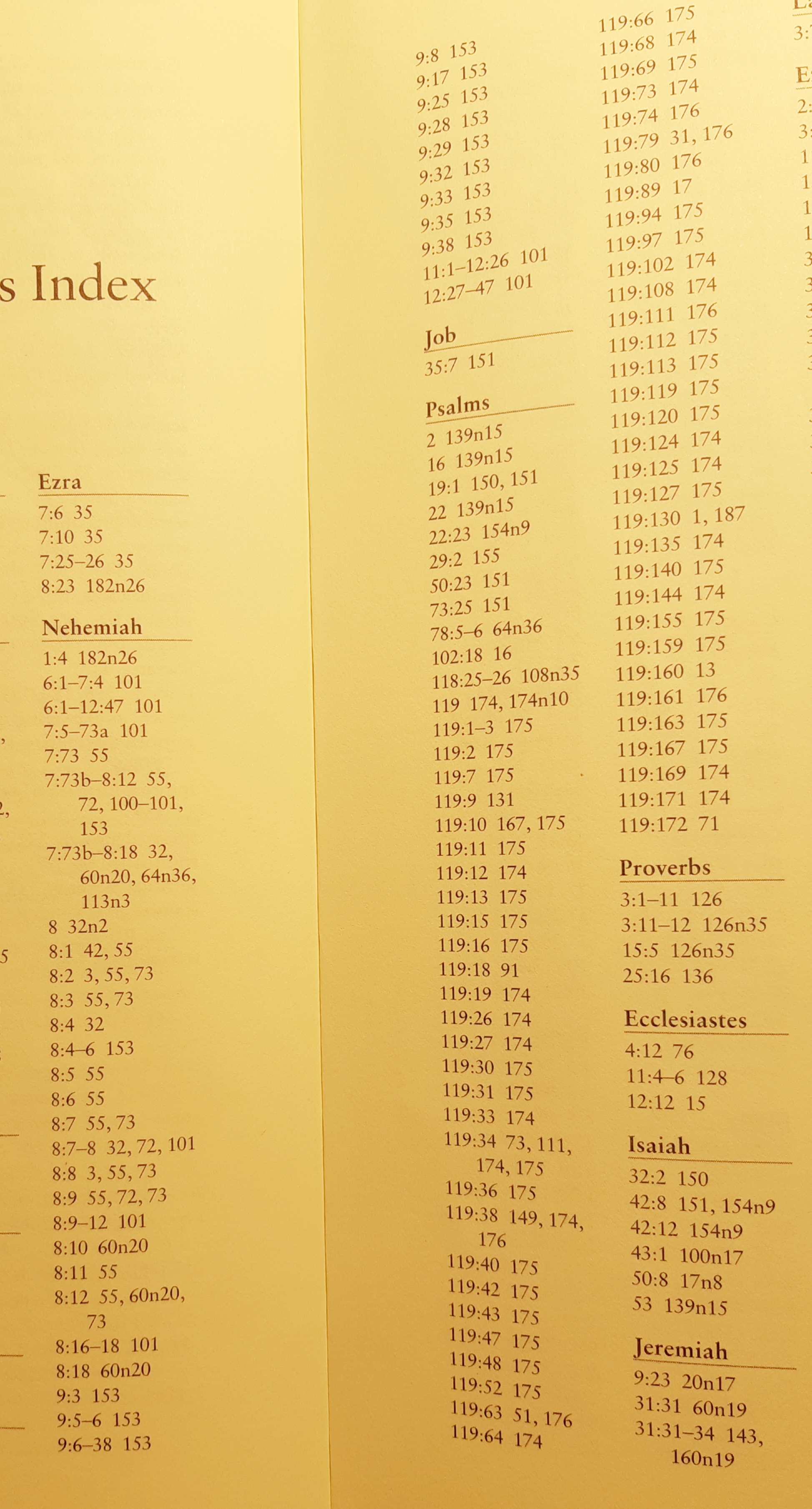
Every chapter starts with an extract from Psalm 119. Every chapter concludes with a Summary section. It is so helpful. Almost every chapter seems to return to Nehemiah 8, ‘functioning almost as a paradigm for preaching’ (32). Love it. The opening session of every entry level seminar in all the Langham training I’ve ever done commences with Nehemiah 8 & 9. [NB: the photo shows the way Nehemiah 8 and Psalm 119 dominate the Index, as discovered in the pale light of an early morning lamp!].
The Summary section is followed in each chapter by a Reflection from Mark’s gospel. This was a laudable effort to anchor what he is saying in the text of actual Scriptures.
Kuruvilla touches down in church history, a lot. I cannot think of a book on preaching that does it more, other than those books specifically on the history of preaching. I appreciated it.
It is not in this book, as far as I could see, but in a podcast which I watched, Kuruvilla speaks of the criteria he uses to evaluate student sermons. It is pretty much the same as what we do in Langham Preaching: faithful to the text; clear in presentation; relevant to the audience. But Kuruvilla adds one more. I think he’s right … … interesting. The sermon needs to be interesting and targeting faithful-clear-relevant is no guarantee of ending up with a sermon that is interesting.