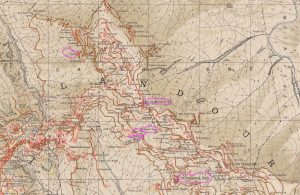
Because of it, his books take so long to read, especially this one where he traces the journey of a Byzantine monk through Greece, Turkey, Syria, Lebanon, Palestine and Egypt: From the Holy Mountain: A Journey in the Shadow of Byzantium – otherwise sub-titled A Journey Among the Christians of the Middle East. Such an evocative difference in sub-titles! I reckon I could write an entire post suggesting the reasons behind the difference…😀

I’ll go with the latter because that is where the impact of the book lies for me. First published more than twenty years ago (in 1997), it is the sobering story of dying Christian communities right there in the ancient heartland of the Middle East. In telling the story of the Middle East, historians can easily make this jump from Constantine to the Crusades, deftly stepping over the way Christian communities were crushed out of existence during those intervening years. And yet, in the first three hundred years of that era, ‘the Eastern Mediterranean world was almost entirely Christian … (it was) the heartland of Christianity and the centre of Christian civilization’ (16,17).
This ‘sobering story’ is very much on Dalrymple’s mind, as he travels and writes. He opens with it and closes with it. The Byzantine monk is John Moschos (‘an almost exact contemporary of Mohammed’, 17) and his AD578 journey is recorded in his little book The Spiritual Meadow, ‘the great masterpiece of Byzantine travel writing’ (13). Moschos witnesses ‘the last days of the golden age of the Christian Middle East’ (453):
The ever-accelerating exodus of the last Christians from the Middle East today meant that The Spiritual Meadow could be read less as a dead history book than as the prologue to an unfolding tragedy whose final chapter is still being written (19).
Christianity is an Eastern religion which grew firmly rooted in the intellectual ferment of the Middle East. John Moschos saw that plant begin to wither in the hot winds of change that scoured the Levant of his day. On my journey in his footsteps I have seen the very last stalks in the process of being uprooted. It has been a continuous process, lasting nearly one and a half millennia. Moschos saw its beginnings. I have seen the beginning of its end (453-454).
So whether it be the descendents of the Byzantines (Istanbul, Turkey), the Armenians (Turkey), the Suriani (Turkey-Syria), the Nestorians (Iraq), the Marionites (Lebanon), the Palestinians (occupied Palestine), or the Copts (Egypt) – Dalrymple wanders into their communities and their monasteries and discovers their stories. It is as sad as it is exhilarating to read.

It is hard to match the grief in the Armenian and Palestinian stories. As I travel, I’ve made a commitment to visit any Armenian churches that still exist (like in Yangon, Myanmar, some years ago – and in Kolkata, India, two months ago). I’ve also decided to speak up and speak out even more about the Palestinan cause because the politically-constructed state of Israel should be referred to simply as ‘occupied Palestine’ as that is pretty much what it is.
Dalrymple hears many stories about ‘the mysterious disappearance of Armenian remains’ (83) and at one point quotes a friend (George) at the Armenian Museum in Jerusalem as saying, ‘every passing year another Armenian church disappears and for this the Turkish authorities can only be pleased … Soon there will be no evidence that the Armenians were ever in Turkey. We will have become a historical myth’ (88). A little later, while visiting the monastery in Mar Gabriel (see the map above), Dalrymple encountered the son of a priest who uttered the sentence that knifed its way through me, more than any other in the book:
It is hard to believe that just one hundred years ago, 52% of Jerusalem was Christian. I have a friend whose family has lived in Bethlehem for one thousand years continually, and in the blink of an eye, historically speaking, it somehow ceases to become their home. Quoting a local historian, commenting on the Museum of the History of Jerusalem, Dalrymple writes, ‘… the Israelite period only lasted six hundred years, but all the periods which followed it are represented as a chain of occupations – Persian, Byzantine, Mamelduke, Ottoman and British … (and in the museum) the word ‘Arab’ does not even appear once in a vast display covering more than thirty rooms’ (334).
Few Western Christians are aware of the degree of hardship faced by their co-religionists (ie Palestinian Christians) in the Holy Land, and the West’s often uncritical support of Israel frankly baffles the Palestinian Christians who feel their position being eroded year by year. (As one church leader expresses it): Had we been Jews and our churches been synagogues, the desecration we have suffered would have caused an international outcry. But because we are Christians no one seems to care (359).

One way we can respond, each one of us, is ‘to take up and read’, in the words of St Augustine. It is hard to believe that Dalrymple is not yet 30 years of age when he takes this pilgrimage. His sunny style, mixing courage with curiosity and empathy, takes the reader in and out of the lives of so many people, opening our hearts to their communities. Along the way there are so many fascinations: how Islam is considered, early on, to be ‘a heretical form of Christianity’ (168-169; see also 104-106, 159-171, 298-305); the stories of Celtic Christianity’s dependence on Eastern (106-111) and Coptic Christianity (411-422); the haunting anticipation of Syria’s recent troubles (146-156); the drive from Damascus to Beirut, the last part of which I did three times in 2019 (200-206); the intrigue in the town of Bsharre in Lebanon, home of Khalil Gibran (236-260); the visit to John Moschos’ home monastery, near Bethlehem (279-309); the rendering of Christian sites to be invisible in and around Jerusalem (326-338); the horrific example of the Israeli treatment of the Palestinians (362-372); the syncretism in Alexandria (385-386); and some of his best writing, mixed with explanations of early monasticism, come with his visit to the monastery of St Anthony the Great in Egypt (395-415) … all added for my own benefit so that I do not forget them!
nice chatting
Paul
PS: There are a crucial few paragraphs near the end of the book. A little longer and so I am adding it as a ‘PS’ for those who are keen and so that I do not lose them myself (with the underlinings being my additions – and remember that Dalrymple is writing more than twenty years ago!):
When I began this journey I had expected that Islamic fundamentalism would prove to be the Christians’ main enemy in every country I visited. But it had turned out to be more complicated than that.
In south-east Turkey the Syrian Christians were caught in the crossfire of a civil war, a distinct ethnic group trodden underfoot in the scrummage between two rival nationalisms, one Kurdish, the other Turkish. Here it was their ethnicity as much as their religion which counted against the Christians: they were not Kurds and not Turks, therefore they did not fit in. In Lebanon, the Marionites had reaped a bitter harvest on their own sowing: their failure to compromise with the country’s Muslim majority had led to a destructive civil war that ended in a mass emigration of Christians and a proportional diminution in Marionite power. The dilemma of the Palestinian Christians was quite different again. Their problem was that, like their Muslim compatriots, they were Arabs in a Jewish state, and as such suffered as second-class citizens in their own country, regarded with a mixture of suspicion and contempt by their Israeli masters … Only in Egypt was the Christian population unambiguously threatened by a straightforward resurgence of Islamic fundamentalism and even here such violent fundamentalism was strictly limited to specific Cairo suburbs and a number of towns and villages in Upper Egypt…
But if the pattern of Christian suffering was more complex than I could possibly have guessed at the beginning of this journey, it was also more desperate. In Turkey and Palestine, the extinction of the descendents of John Moschos’s Byzantine Christians seemed imminent; at current emigration rates, it was unlikely that either community would still be in existence in twenty years. In Lebanon and Egypt the sheer number of Christians ensured a longer presence, albeit with ever-decreasing influence. Only in Syria had I seen the Christian population looking happy and confident, and even their future looked decidely uncertain, with most expecting a major backlash as soon as Asad’s repressive minority regime began to crumble (447-448).
At this point my mind imagines another book, as my heart drifts across to Christian communities elsewhere in North Africa and in that ‘belt’ across the continent, just south of the Sahara. Are they receiving the solidarity which they need? Or, are we going to be too late with them as well?
About Me

the art of unpacking
After a childhood in India, a theological training in the USA and a pastoral ministry in Southland (New Zealand), I spent twenty years in theological education in New Zealand — first at Laidlaw College and then at Carey Baptist College, where I served as principal. In 2009 I began working with Langham Partnership and since 2013 I have been the Programme Director (Langham Preaching). Through it all I've cherished the experience of the 'gracious hand of God upon me' and I've relished the opportunity to 'unpack', or exegete, all that I encounter in my walk through life with Jesus.
Recent Posts

Football helps me train preachers. See, when you speak to me about football—or, ‘footie’—I need to know where your feet are before I can understand what you mean. Are your feet in Ireland, or Brazil, or the USA, or NZ—or in crazy Australia? It must be the most fanatical sporting nation in the world. Within…
Having been born in 1959, I don’t remember much about the 1960s. But I have heard a lot. Hippies. Drugs. Rock ‘n Roll. Assassinations. Moon-walking. A quick trip across to ChatGPT informs me immediately that it was ‘a transformative decade across the world’—marked by the civil rights and feminist movements, Cold War tensions, consumerism and…