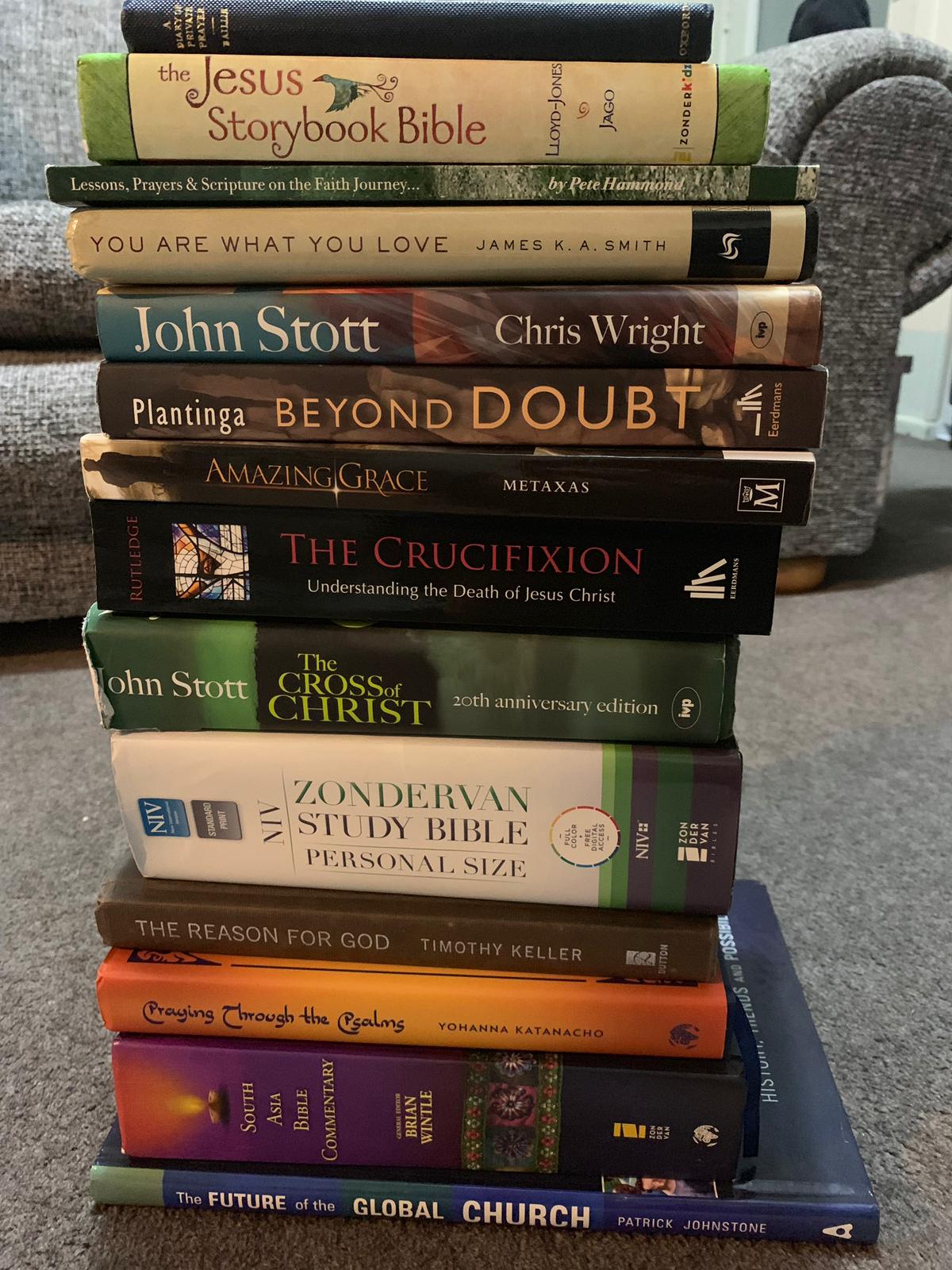
We’d been doing it for awhile, but fresh momentum came at a couple of different times. One was when John Stott died in 2011. He had been such a massive influence in my life and I wanted a deposit of that legacy to find its way into the lives of our children. I remember selecting, very thoughtfully, two different Stottian books for each one of our five children.
The second was when we moved away from home to go and live in South Asia. We felt the distance in more ways than we anticipated. One was the sense of losing a voice of influence in the lives of our children, as they set off in their different vocations and locations and communities. Giving them, every now and then, a significant book (to me, anyway!) seemed to be one way to keep speaking a little voice into their lives.
Whether they take the time to read them is a different matter altogether 😀.
In my 60th year, another reason to give them books came into focus. After a decade of working in a majority-world context, I found myself wanting my children to be more exposed to majority-world authors writing from within those contexts. Here is the inscription I placed in three books given to them on the occasion of this birthday.

There is a little irony in all of this. The churches outside the majority world (like in my home of New Zealand) are pragmatic. The context is tough. I am full of admiration for biblically-faithful pastors. ‘No religion’ statistics are raining down on them. The church is in decline. Understandably, they are on the look-out for ideas that work and bring success. But here is the irony. They tend to keep looking for these ideas from other places where the church is in decline! Why? I don’t understand it. I am old enough now. I’ve seen it again and again over the decades. These ideas build like waves out to sea, and as they rise, churches ride them – until they crash into the sand and disappear. The next big thing, yet again, has become the most recent little thing, at great cost and with little influence. Why not turn to places where churches are on the rise and people are coming to faith in Christ in huge numbers – like in so many places in the majority-world? Is there not something we can learn from them?
[NB: Two possible reasons for not turning that way come to mind. One, as my friend put it yesterday, is that no one puts up their hand for suffering. Living under fire sounds too hard. Fitting-in and going with the flow is easier than standing-out and going against the flow. Books about cultural relevance are easier than books about cultural resistance. It looks like a tough world for Christians over here in the majority-world. It is. A second reason might be the sheer wealth and power and reach of publishing houses, with their authors and seminars, outside the majority world. The marketing can batter people into purchase, while the focus has to be on books that people want (ie that sell), rather than the books that people need.]
We need to find a better way. Pastors, leaders and thinkers outside the majority-world need to grow some gurus from within the majority-world. It will be so good for them.
WHY?
1. To Learn
People tend to live in bubbles, prefering to hear only the reassuring echoes of what they already believe. Same authors. Same schools. Same publishers. Same organisations. What they really need to do is burst out of their bubbles and venture forth. Living in multi-cultural societies might be new for us, but it is ancient for many in the majority world. Bearing witness as a minority faith in a majority faith religious context (and yes, the ‘no religion’ folks do form a majority faith religious context) might be new to us, but it is ancient for many of them. Discovering that a biblically-faithful life invites persecution in the public world might be new to us, but it is ancient for many of them. If this is all true, then why, for God’s sake, are we not more willing to learn from them?
2. To Change
If it is the bubble that is the concern above, then it is the blindspot that is the issue here. Using the language of the scholar for a moment, we can affirm that all knowledge is ‘perspectival’ and that there is a ‘pre-understanding’ that we bring to the text before we even open the text. We gotta find ways to get in and mess with that perspective and that pre-understanding because you can be sure there are blindspots in there that are at work. The best way to do this is to read familiar things through other peoples’ eyes. The suffering church sees different things in the text than the comfortable church. My next literary task is take a final look at a book by a Palestinian scholar entitled, Reading the Gospel of John through Middle-Eastern Eyes. Yes! This is how to expose blindspots – and it is also a jolly good way to melt the fears and evaporate the threats which so often surface when we encounter something that is alien to us.
3. To Identify
It is a small step from ‘reading through other peoples’ eyes’ and beginning to identify with them. This is how friendships are built. This is how partnerships get started. This is how solidarity seeps in. This is what we need to heal our lands and assist God with his mission in the world. Let’s give our lives not just to the unity of the local church, but also to the global church. Let’s extend the canvas on which we paint those experiences of ‘weeping with those who weep’. Let’s see churches in the majority-world and churches outside the majority world getting it together. The books will help. In fact, the books can lead the way…
Yep – pastors, leaders and thinkers outside the majority-world need to grow some gurus from within the majority-world. It will be so good for them.
2. Start with Hikmat Kashouh’s Following Jesus in Turbulent Times. It is short. It is engaging. It is a simple apologetic for the value of all that I am affiming with this post. While I did write a little review here, it is far better that you read the book for yourself. Another good starting place would be Ajith Fernando, but you’ll need to push your cart on another website for his books, starting with The Call to Joy and Pain; The Family Life of a Christian Leader; and Discipling in a Multi-cultural World.
3. Purchase a one-volume commentary.

A personal favourite of mine is the volume by Conrad Mbewe – which I blogged about here, before the book was published and after I heard the story from Conrad himself at a table in a restaurant in Sheffield. Interestingly, one of the unexpected consequences of the Langham Monographs series is that they are proving to be very popular with seminaries and colleges outside the majority-world. That is a good sign, isn’t it?!
You can kinda tell that I’ve had two unexpected days in Beirut!
nice chatting
Paul
About Me

the art of unpacking
After a childhood in India, a theological training in the USA and a pastoral ministry in Southland (New Zealand), I spent twenty years in theological education in New Zealand — first at Laidlaw College and then at Carey Baptist College, where I served as principal. In 2009 I began working with Langham Partnership and since 2013 I have been the Programme Director (Langham Preaching). Through it all I've cherished the experience of the 'gracious hand of God upon me' and I've relished the opportunity to 'unpack', or exegete, all that I encounter in my walk through life with Jesus.
Recent Posts

Football helps me train preachers. See, when you speak to me about football—or, ‘footie’—I need to know where your feet are before I can understand what you mean. Are your feet in Ireland, or Brazil, or the USA, or NZ—or in crazy Australia? It must be the most fanatical sporting nation in the world. Within…
Having been born in 1959, I don’t remember much about the 1960s. But I have heard a lot. Hippies. Drugs. Rock ‘n Roll. Assassinations. Moon-walking. A quick trip across to ChatGPT informs me immediately that it was ‘a transformative decade across the world’—marked by the civil rights and feminist movements, Cold War tensions, consumerism and…


Amen, Brother!
As a WWW (Wealthy White Westerner) I have benefited so much from my exposure to Majority World authors, both in print and in person.
Yes, Ross – how true.
There are also plenty of alternative voices for those of us who are stale-pale-male!
Thanks for dinner. A lovely evening with good friends.
Paul
I love the South Asia Bible Commentary. As I have been interacting cross culturally with South Asians in Italy for 20 years or so (met the first one less than a year after returning to Italy) and having visited one South Asian nation, I love this commentary also because there are many cultural elements in common between Southern Italy and South Asia.
That is great to hear, Andrew. It's presentation and it's content are both of the highest quality.
Blessings
Paul
Dear Uncle,
This is great. Thank You for the Post.
Beautifully presented.
As i was browsing through the different lables I was drawn to book review section. And as I was scrolling down the different headings I saw the pictures of different books, immediately I clicked it and started to go through. I started to search for the books mentioned in the list and came across, "The Crucifixion: Understanding the Death Of Jesus Christ. Thank You Uncle. I am going through the book.
Kia ora Paul. I am wondering if you know whether the South Asia Bible Commentary might become available in Accordance? I note that some other Langham resources are there, and it would mean that the commentary could be in constant use whenever I am searching the scriptures!
Regards,
Hamish Baxter