But what about the unity of the Bible? Yes, the Bible as a single story by a single (divine) author? It didn’t seem to feature as much in my training way back then. I’ve been playing a game of seemingly endless catch-up over the last decade or two. I’ve had to read and think and teach my way into this world … and I’ve been so glad to find books (there are heaps of them out there) to help me.
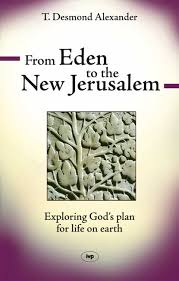
T. Desmond Alexander’s From Eden to the New Jerusalem is right up there. The one I’ve read most quickly. So stimulating, so fascinating. I’ve never opened a book with so many footnotes that is so easy and engaging to read.
For Alexander, the Bible is a ‘meta-story’ (which I have always understood to mean the story by which all other stories make sense) in that it ‘addresses two of life’s most fundamental questions: (1) Why was the earth created? (2) What is the reason for human existence?’ (10). To find the answers in this literary anthology we know as the Bible it is best to begin at the end. Revelation 20-22. Alexander sees ‘very strong links’ between these chapters and the opening three chapters, Genesis 1-3. His book is about demonstrating those links but then he also shows how the story grows and threads and deepens its way from that Genesis to Revelation. The plotline doesn’t change. Fascinating, eh?!
Here, take a look at the chapter titles (with an added explanatory quotation), as they identify the Revelation-truth which then (a) he finds embedded in the early Genesis story, before (b) tracking it through the entire biblical story:
1. From sacred garden to holy city: experiencing the presence of God
From the outset of creation, God intended that the earth would become a holy garden-city in which he would dwell alongside human beings. However, the disobedience of Adam and Eve jeopardized this divine project … In the process of recovering the earth as his dwelling place, God progressively established the tabernacle, the Jerusalem temple and the church (74).
2. Thrown from the throne: re-establishing the sovereignty of God
By betraying God and obeying the serpent, the royal couple dethrone God. Adam and Eve, commissioned by God to play a central role in the building of his holy garden-city, not only forfeit their priestly status but also betray the trust placed in them to govern the earth. The ones through whom God’s sovereignty was to be extended throughout the earth side with his enemy. By heeding the serpent they not only give it control over the earth, but they themselves becomes its subjects … One day this present age will give way to another, when the earth will be rejuvenated and the sovereignty of God will finally become an undisputed reality in the New Jerusalem (78-79, 97).
3. Dealing with the devil: destroying the source of evil
By obeying the serpent, Adam and Eve take on his image and defile the earth. While Adam and Eve’s actions have terrible consequences, all is not lost, for God introduces the idea that the serpent will be overcome through an offspring of the woman. From Genesis 4 onwards the reader’s attention is directed to this offspring … Whereas the Old Testament looks forward to the defeat of God’s enemies and the establishment of his reign upon the earth, the New Testament presents Jesus Christ as the one who overthrows Satan … Stripped of his power, he will no longer, as ‘rule of this world’, be able to champion the cause of evil. Every vestige of Satan’s influence will be destroyed (107, 111-112, 118).
[NB: Don’t miss the three pages on ‘Resisting the Devil’ (118-120) – so helpful].
4. The slaughter of the Lamb: accomplishing the redemption of creation
Although the enemy, ‘the dragon, that ancient serpent, who is the devil and Satan’, is presently ‘ruler of this world’, his days are numbered and he will ultimately be vanquished. Crucial to the demise of Satan is Jesus Christ, for he is the one who overcomes the devil. Remarkably, John’s description of the New Jerusalem in Revelation 21-22 contains no specific reference to the name of Jesus Christ … However, each time he is mentioned, he is designated by the title ‘the Lamb’ (5x) … reminiscent of the divine deliverance of the Israelites from bondage in Egypt … However, whereas the first exodus was principally about rescuing the Israelites from slavery, John has in view a new exodus that brings about the deliverance of people ‘from every nation, from all tribes and peoples and languages’ (121-122, 124, 125).
5. Feasting from the tree of life: reinvigorating the lives of people from every nation
John’s vision of the New Jerusalem anticipates human existence as we have never known it. The life to come will be truly abundant and fully satisfying [particularly as it relates to the role of three themes: holiness/wholeness, tree of life and the nations] … When Jesus heals, it is about restring people to the holy status Adam and Eve enjoyed before sinning … Citizens of the new earth will experience and enjoy both wholeness of body and longevity of life. They will have a quality of life unrestricted by disability or disease. To live in the New Jerusalem is to experience life in all its fullness and vitality. It is to live as one has never lived before. It is to be in the prime of life, for the whole of one’s life … John’s vision of the New Jerusalem introduces an important international dimension, reflected in three references to the ‘nations’ (138-139, 153, 156, 163).
6. Strong foundations and solid walls: living securely among the people of God
Maybe you are still thinking what I am still thinking.
Can he really make a case for all that stuff going on in Genesis 1 & 2 & 3?!
Yes, he makes a pretty convincing case for it.
It is such an absorbing read.
Methinks the book has the makings of a sermon series in it for 2017 – or, at least, a series of serious small group studies? Go for it.
nice chatting
Paul
About Me

the art of unpacking
After a childhood in India, a theological training in the USA and a pastoral ministry in Southland (New Zealand), I spent twenty years in theological education in New Zealand — first at Laidlaw College and then at Carey Baptist College, where I served as principal. In 2009 I began working with Langham Partnership and since 2013 I have been the Programme Director (Langham Preaching). Through it all I've cherished the experience of the 'gracious hand of God upon me' and I've relished the opportunity to 'unpack', or exegete, all that I encounter in my walk through life with Jesus.
Recent Posts



Football helps me train preachers. See, when you speak to me about football—or, ‘footie’—I need to know where your feet are before I can understand what you mean. Are your feet in Ireland, or Brazil, or the USA, or NZ—or in crazy Australia? It must be the most fanatical sporting nation in the world. Within…
Having been born in 1959, I don’t remember much about the 1960s. But I have heard a lot. Hippies. Drugs. Rock ‘n Roll. Assassinations. Moon-walking. A quick trip across to ChatGPT informs me immediately that it was ‘a transformative decade across the world’—marked by the civil rights and feminist movements, Cold War tensions, consumerism and…