But over time I have become dissatisfied with the body.
During these four years with Langham, working more in a grassroots setting across a dozen countries around Asia and the Pacific, I have been experimenting with a different metaphor. The map. Here is a summary sheet I developed for a seminar in Australia. (NB: just click on it and it should become readable).
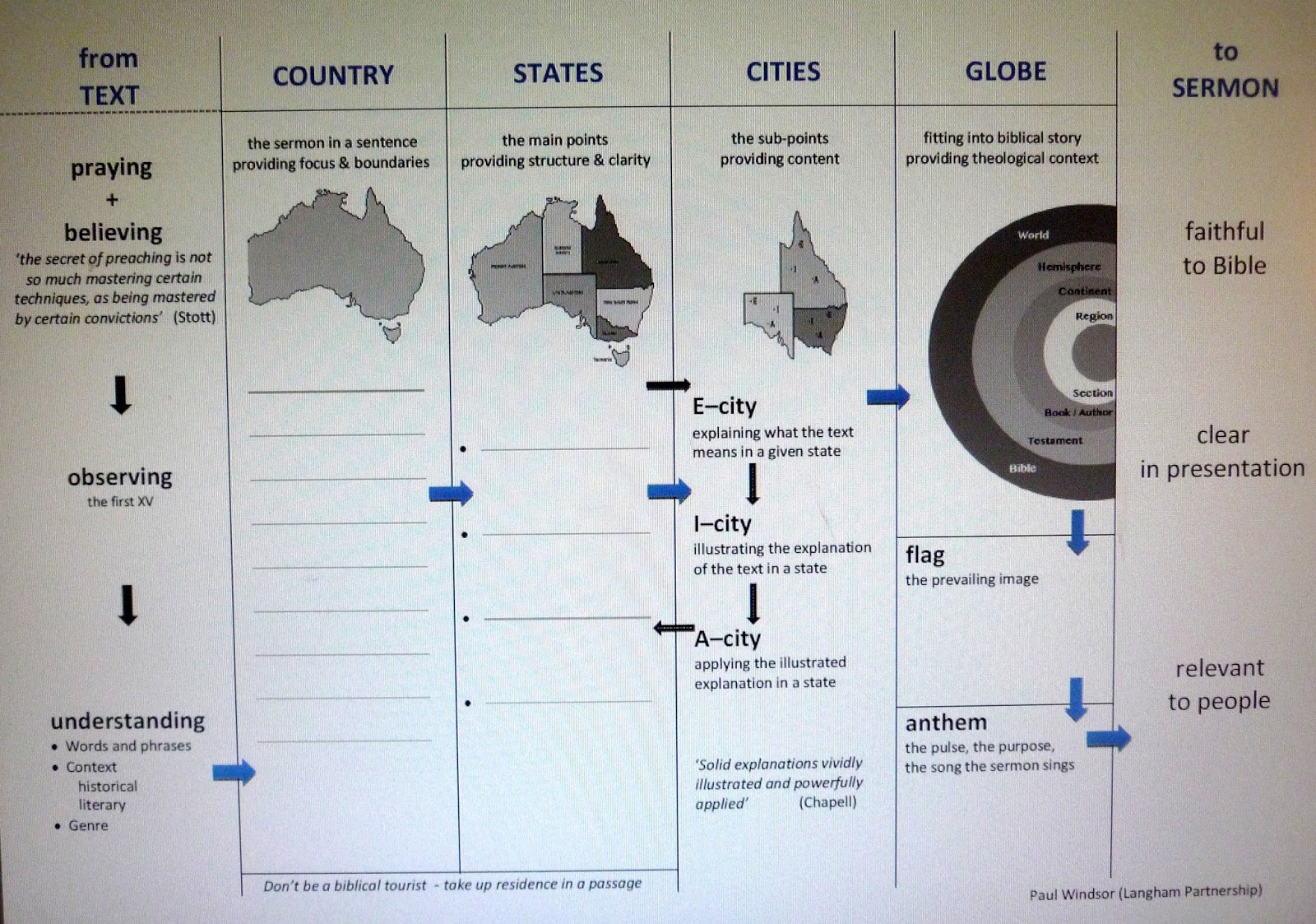
The key components of this metaphor are:
the country: the sermon in a sentence (determined by the ‘big idea’ in the text)
the states: the main points of the sermon
the cities: three of them in each state: explanation, illustration, application
the global: placing passage/sermon in wider biblical context (biblical theology)
the flag: a prevailing image for the sermon
the anthem: the pulse and purpose of the sermon
It isn’t perfect! Like any metaphor, it has its limitations. And it isn’t being used in every country (but some do love it!). Here are some of the reasons why I prefer it to the body…
1. Country:state clarifies the relationship between a main point and the big idea – something which the head:skeleton leaves ambiguous. A main point needs to be found in the big idea (and therefore the passage itself), like a state is found within a country. This keeps the flow of the sermon in the passage. A generation of students working with the body would find a big idea, but then tend to start all over again to find the main points. A skeleton is an extension of the head, rather than in the head, and this is problematic for me.
2. It is a fuller metaphor. It includes more into the process. For example, the flag adds a visual dimension, while the anthem adds an affective dimension to the preparation. These are the very areas where exposition (a phrase I do not use any more, by the way – just too many unhelpful stereotypes) can be vulnerable. Engaging the eye and the heart, if you like. Plus, when it comes to engaging and evaluating the sermon, this fullness creates a wider and far more rewarding conversation.
3. It is a metaphor which different contexts can make their own. An island nation can opt for country:island:village, instead of country:state:city – while a metropolitan area gravitates towards city:suburb:street. I find they love this opportunity for indigeneity – and it subverts a bit of the Western ‘feel’ which can accompany exposition.
4. In the model, the preacher must illustrate and apply the message all the way through the sermon. They visit the explanation, illustration and application cities in each of their states. It is a good idea to put this pressure on biblical preachers – always loving the explanation of the text, but for whom illustration and application can become an afterthought.
5. It draws attention to the importance of placing the passage being preached within the flow of the biblical story (the globe). It makes biblical theology a priority in a way that the body does not do so naturally.
6. One of the persistent critiques of exposition is that it is static as it can become weighed down with proposition. In using the metaphor of a map, the related metaphor of journey is not far away. Quite explicitly, the movement from text to sermon becomes a journey. As I teach it I am stepping my way through the various stages, as we move from city to city, and state to state, within a country. It forces the preacher to think, and then verbalise, one of the most overlooked areas in preaching – the transitional sentence.
nice chatting
Paul
About Me

the art of unpacking
After a childhood in India, a theological training in the USA and a pastoral ministry in Southland (New Zealand), I spent twenty years in theological education in New Zealand — first at Laidlaw College and then at Carey Baptist College, where I served as principal. In 2009 I began working with Langham Partnership and since 2013 I have been the Programme Director (Langham Preaching). Through it all I've cherished the experience of the 'gracious hand of God upon me' and I've relished the opportunity to 'unpack', or exegete, all that I encounter in my walk through life with Jesus.
Recent Posts
Football helps me train preachers. See, when you speak to me about football—or, ‘footie’—I need to know where your feet are before I can understand what you mean. Are your feet in Ireland, or Brazil, or the USA, or NZ—or in crazy Australia? It must be the most fanatical sporting nation in the world. Within…
Having been born in 1959, I don’t remember much about the 1960s. But I have heard a lot. Hippies. Drugs. Rock ‘n Roll. Assassinations. Moon-walking. A quick trip across to ChatGPT informs me immediately that it was ‘a transformative decade across the world’—marked by the civil rights and feminist movements, Cold War tensions, consumerism and…