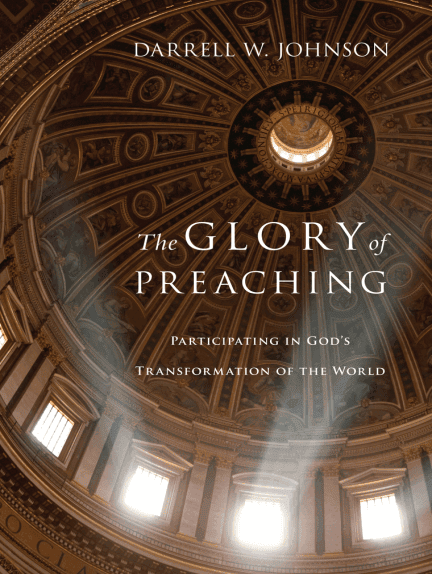
How ironic is this…
For example:
(a) his definition of preaching emphasizes the need to be “causing a shift in worldview” – YES!;
(b) he makes space for the significance of the parable of the sower/seed/soils – YES!;
(c) he has such a high view of the Bible – informing, transforming and performing – YES! (“our task as preachers is to open the text in such a way that the text itself does what only the text can do” – 165);
(d) he includes an entire chapter on “the many-verbed wonder (which is) the preaching moment” (98) – YES! (even classifying them into four quadrants – “hold me back lest I swoon”);
(e) he lingers with the importance of mere observation of what the text is in saying and with a genre-sensitivity – YES!;
(f) he includes his manuscript of a sermon and he does it just like I do – so unlike an essay – YES!
For example:
(a) ‘truth through personality’ becomes “personhood” as he takes us through Temperament, Woundedness, and Gifting (“burnout in ministry does not result from overworking; burnout results from not honouring who we are and instead trying to be who we think we ought to be” – 190);
(b) betraying his experience in Asia, he puts postmodernity (and the new atheism, I might add) in its place – pleading with the reader to open their eyes and realise that in the future inter-faith issues are going to be of far more consequence than lack-of-faith issues;
(c) keeping the sociologists and the marketers at arm’s length a bit, he questions aspects of the pursuit or relevance and the place of seeker-sensitivity. In effect – ‘if you are going to let those guys define the problem you may find yourself checking them out for the total solution as well … and the drift from the gospel has begun’.
(d) affirming the need for the Spirit at work at both ends, saved appropriately for his concluding chapter;
(e) having a little word for those who tend to be intimidated by the visual as preachers – “the power of a film does not lie in its sights alone but also in its sounds” (145).
For example:
(a) the case he makes for continuing to handwrite his notes, rather than using a word-processor (135);
(b) the case he makes for application not being the preacher’s responsibility – rather it is “implication” – “to expect preachers to apply the text for their listeners is to ask them to play God … the pressure to apply is a modernist pressure, not a biblical pressure” – 159);
(c) the way he plans for the next year’s special service immediately after this year’s version – “why wait for a few weeks or months? Late Christmas Eve is the best time to prepare (for next year) because, one, all the sounds and smells and sights of the celebration are fresh in my senses and, two, I know what I did not preach for lack of time and wished I could have” – 210).
About Me

the art of unpacking
After a childhood in India, a theological training in the USA and a pastoral ministry in Southland (New Zealand), I spent twenty years in theological education in New Zealand — first at Laidlaw College and then at Carey Baptist College, where I served as principal. In 2009 I began working with Langham Partnership and since 2013 I have been the Programme Director (Langham Preaching). Through it all I've cherished the experience of the 'gracious hand of God upon me' and I've relished the opportunity to 'unpack', or exegete, all that I encounter in my walk through life with Jesus.
Recent Posts


Football helps me train preachers. See, when you speak to me about football—or, ‘footie’—I need to know where your feet are before I can understand what you mean. Are your feet in Ireland, or Brazil, or the USA, or NZ—or in crazy Australia? It must be the most fanatical sporting nation in the world. Within…
Having been born in 1959, I don’t remember much about the 1960s. But I have heard a lot. Hippies. Drugs. Rock ‘n Roll. Assassinations. Moon-walking. A quick trip across to ChatGPT informs me immediately that it was ‘a transformative decade across the world’—marked by the civil rights and feminist movements, Cold War tensions, consumerism and…



"'why can't just one of those books serve as a textbook in just one of those years in the classroom'"
…You mean Doug Pagitt didn't fill that void? 😉
Seriously though Paul, do you rate this one above "Between To Worlds"?
Thank-you, Rhett
No – Pagitt's book didn't come to mind when I thought 'textbook'. Your powers of perception are immense. It must be the training.
And yes, (if I must) I would rate Stott's book ahead of Johnson's as a book on preaching (of course!) – but then I wouldn't put Stott's book in the category of 'textbook' – in that he does not give much guidance and moving from text to sermon, for example.
Missed my first ever 'sending' last night. Boy – did that feel wierd, or what?! But the good ship Carey seems to be travelling just fine and I trust that you have had a good year.
Fair call :-). It was a great and enjoyable evening… And with Mr Hewlett sitting up there, if you squinted your eyes a bit it was almost like still having you around!
Thanks for the "heads-up" Paul. I'm intruigued by this: (b) the case he makes for application not being the preacher's responsibility – rather it is "implication" – "to expect preachers to apply the text for their listeners is to ask them to play God … the pressure to apply is a modernist pressure, not a biblical pressure" – 159).
This is something I've been considering for a while now. Perhaps due to my own contexts which are so varied, a sermon does not afford time for application. Our lives are all so different, and the applications will be varied depending on the lives we encounter. I still use your audience piece of paper when writing my sermon, but trying to apply it do the different genres of people that make up our congregations – almost impossible. I think general applications are helpful, but specifics are not. The people of God must learn to improvise their own movements in this drama. And as I preacher we can point people to the Script, and then pray and encourage and converse as a fellow performer.
Is that fair?
Thanks for this review Paul. I stumbled across this 2 weeks ago and flicking through it made me immediately add it to the "highly recommended" part of the bibliography. I look forward to my own copy arriving soon…
Yes, Sean – I wrestle with this stuff as well. Application is not my strongest area and there is a bit of pressure around to spoonfeed the people of God. Easy to kinda skip explanation and have the sermon live in illustration and application. Johnson's stuff on 'implication' – backed by his high view of the word of God being let loose – is a corrective to this and merits some reflection.
Yes, Andrew I stumbled across this book within hours of our last conversation on textbooks. Worth a look.
sounds a great book Paul. can i pick up on the definition of expository:
"expository preaching is not about getting a message out of the text; it is about inviting people into the text so that the text can do what only the text can do"
is that really what expository is? and models?
cos that's how I'd define (postmodernally) culturally engaged, narrative sensitive sermons.
i wonder if the definition of exposition is shifting?
steve
http://www.emergentkiwi.org.nz
Thanks. Will be on the top of my list when I next make book purchases
They are good questions, Steve. I've been thinking about them…
Yes, when stated so baldly it is a quotation that suggests what you are inferring. My copy is not with me at the moment – but two things remain with me:
(a) Johnson emphasises the performative nature of the word; that it does things when it is spoken; that it brings things into being often out of nothing – and I think this is what he is trying to underline towards the end of this quotation… Just let the word loose in peoples' lives. It will do something! "Participating" is his metaphor and he is saying – 'get people into the text and let it loose!' … so it is a very high view of the text,
(b) The first half of the quote is odd because a lot of the book IS about getting the message out of the text – and being faithful to it! So I will need to go back and look at the context of what he says a bit more. I guess he is guarded about letting the whole experience being akin to 'dissect-the-dead-frog'. Nah! The word is living and active…
But you sure got me thinking a bit more about it…
thanks Paul.
One of the things I struggle with about the ways I have seen exposition applied is that it seems to suggest a low view of the text. It needs to be explained, by the typically rational mind. It needs to be squeezed into three R's etc.
So I love this talk of participating and letting text be text. That for me is why I think that many tools need to be in preachers toolkits. Take like lectio divina – Let text be text, alive, speaking. Use of communal hearing processes, ways to let the text be alive in God's people.
steve
http://www.emergentkiwi.org.nz
Hi Paul, I am glad to be sitting in your class. Homiletics was one of my favorite subjects (I am yet to be disciplined though)in my previous seminary and I am really fortunate to be learning it again at the right time as a preparation for pastoral/preaching ministry after my graduation in my local Baptist church in Nagaland. I am reminding myself that I should invest my time and effort to be disciplined with the basic skills that we have been discussing in the class. I am looking forward to become more diligent in handling the Word. Shalom!
Great Blog!! That was amazing. Your thought processing is wonderful. The way you tell the thing is awesome.
hyderabad metro rail timings
hyderabad metro train timings