When I first ventured into the world of preaching, the passion was to be bible-based. It still is the passion. To work in such a way that the content and purpose of the text becomes the content and purpose of the sermon. That’s it. But as I became more acquainted with preaching from the Old Testament and with narrative, I added another criterion: being theocentric. That is, to look for God in the passage and build the sermon around him and what he is doing, rather than around the people who look like me in the passage.
It is fair to say that these two criteria – bible-based and theocentric – have been part of the journey for me for some decades. But now, in this most recent decade I’ve tried to add a third growing edge. I used to use the word ‘christocentric’ – but the better word is christotelic, where ‘-telic’ conveys the idea of the destination, or the goal, or the end. Twenty-five years ago, in the week following a series of talks I gave on Ecclesiastes at an Easter Conference in South Auckland, I received a letter slamming my series as ‘synagogue sermons’. They were neither christocentric, nor christotelic! I stewed on that letter for years before acknowledging that the critique was correct.
So, as I tried to express it this year in a seminar in Bolivia on preaching from Old Testament narrative, our preaching needs to be both theocentric (‘God-at-the-centre’) and christotelic (‘Christ-at-the-end’). I tried to illustrate this with sermons from Exodus, Nehemiah and Ruth. God is the hero. He wins Best Actor every single time. Find him. Preach him. [NB: the humans in the story only ever win Best Supporting Actor]. With Christ, as the children’s book expresses it, ‘every story whispers his name’. Speak the whisper. Discover that path. The sermon will be incomplete until it is placed within the whole story of salvation, with its climax in Jesus.
Bible-based. Theocentric. Christotelic. Big Words. Important Words. Growing edges.
Over the past 3-5 years I’ve seen the need for yet another growing edge in my preaching.
Application.
I selected two recent books to be my guides. They are two of the most travelled books in the history of civilisation, resting in my suitcase for numerous long trips – but left unread each time. Not now. They have been read and are being processed. If you like knife imagery, then there is Chris Green’s Cutting to the Heart (IVP, 2015). If you like arrow imagery, there is Murray Capill’s The Heart is the Target (P&R, 2014). Green was devoured in the Pakistani Himalayas, while Capill was absorbed a few hundred metres from the Egyptian Red Sea.
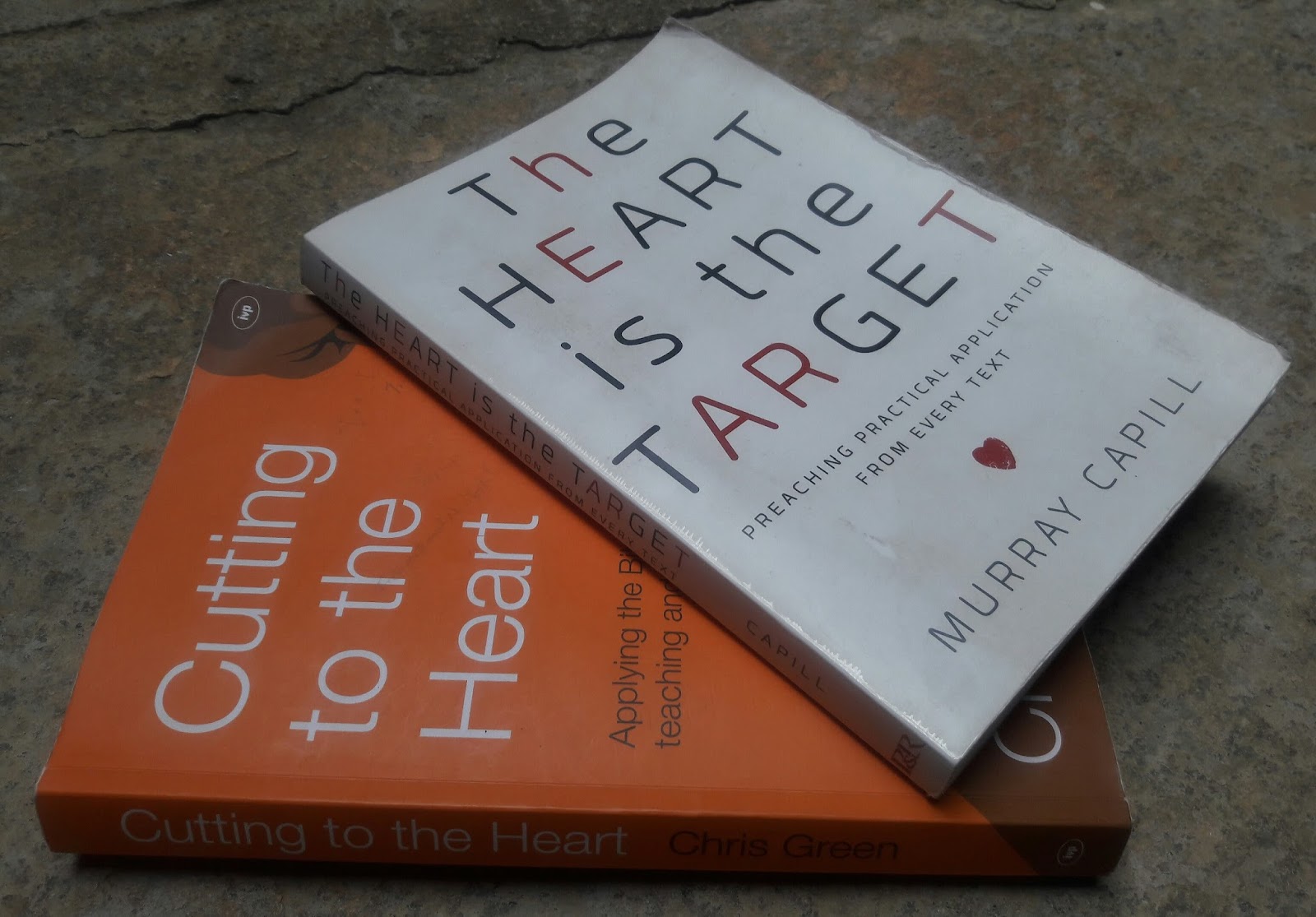
The books are complementary. Green lingers in the rationale for application (leaning towards answering ‘Why?’), mounting his argument one short chapter at a time. Capill moves straight into what he calls ‘the living application preaching process’ (leaning towards answering ‘How?’), breaking it into sections and explaining it one practical step at a time. One originates with lectures at Moore College (Sydney) and the other with a conference at Ridley College (Melbourne). Both even speak about New Zealand – surprise, surprise! Capill is originally from NZ, while Green writes of incurring the wrath of NZers for daring to critique the Lord of the Rings movies – and to do so while visiting NZ (208-213). A brave man indeed – but, as a Kiwi, I agree with his comments.
Actually I had another good chuckle with Green’s book. My guess is that Chris Green (or his editor) is a (late) baby-boomer cricket fan. How can I tell? Because every time he quotes Bryan Chapell (which he does a lot!), he adds another ‘p’ to the name – as if to morph Bryan into the younger brother in the ageing luminous Australian cricketing fraternity of Ian, Greg and Trevor Chappell.
Green is at his best handling the biblical text. From the engagement with Ecclesiastes 12.9-12 (13-19) in the opening pages through to his treatment of passages like Matthew 23.13-32 (89-91 – ‘preaching that makes Jesus angry’), Titus (93-106), and Mark 12.29-31 (130-133). I suspect that he is a fine preacher himself. The ongoing practical help comes with the grids he develops (127-133) around both 2 Timothy 3.16 (teach-rebuke-correct-train) and ‘the greatest commandment’ (heart-soul-strength-mind). He returns to the ‘greatest commandment’ (182-190 – ‘change in four dimensions’), another useful chapter. His discussion of the three critical questions – is it true? is it relevant? is it real? – and assisting preachers in asking and answering them is also valuable (193-207).
I confess that I did not always understand his argument, particularly early on (49-58 being an example). A bit too subtle for me. Plus the critique of John Stott’s ‘between two worlds’ is too nuanced and based too much on ‘reading Stott carelessly’ (74) which doesn’t seem fair to the author, any author. I hope I am not doing it to Chris Green here, for example!
What about Capill’s book?
If you are preaching anything close to regularly or systematically, then I have two words for you: read it. Right now I am scanning my bookshelves here in my office – and imagining all the other preaching books in storage back home … probably a few hundred books on preaching in total. I would struggle to name five books that are more significant than this one. It is beautifully written. It is clear. It is wise. It is simple. It is deep. It is ancient. It is modern. It is pastoral. It is tender. It is bold. It is realistic. It is practical. I intend to deconstruct – and then reconstruct – the session I do on application in time for my November module because of the impact this book has had on me.
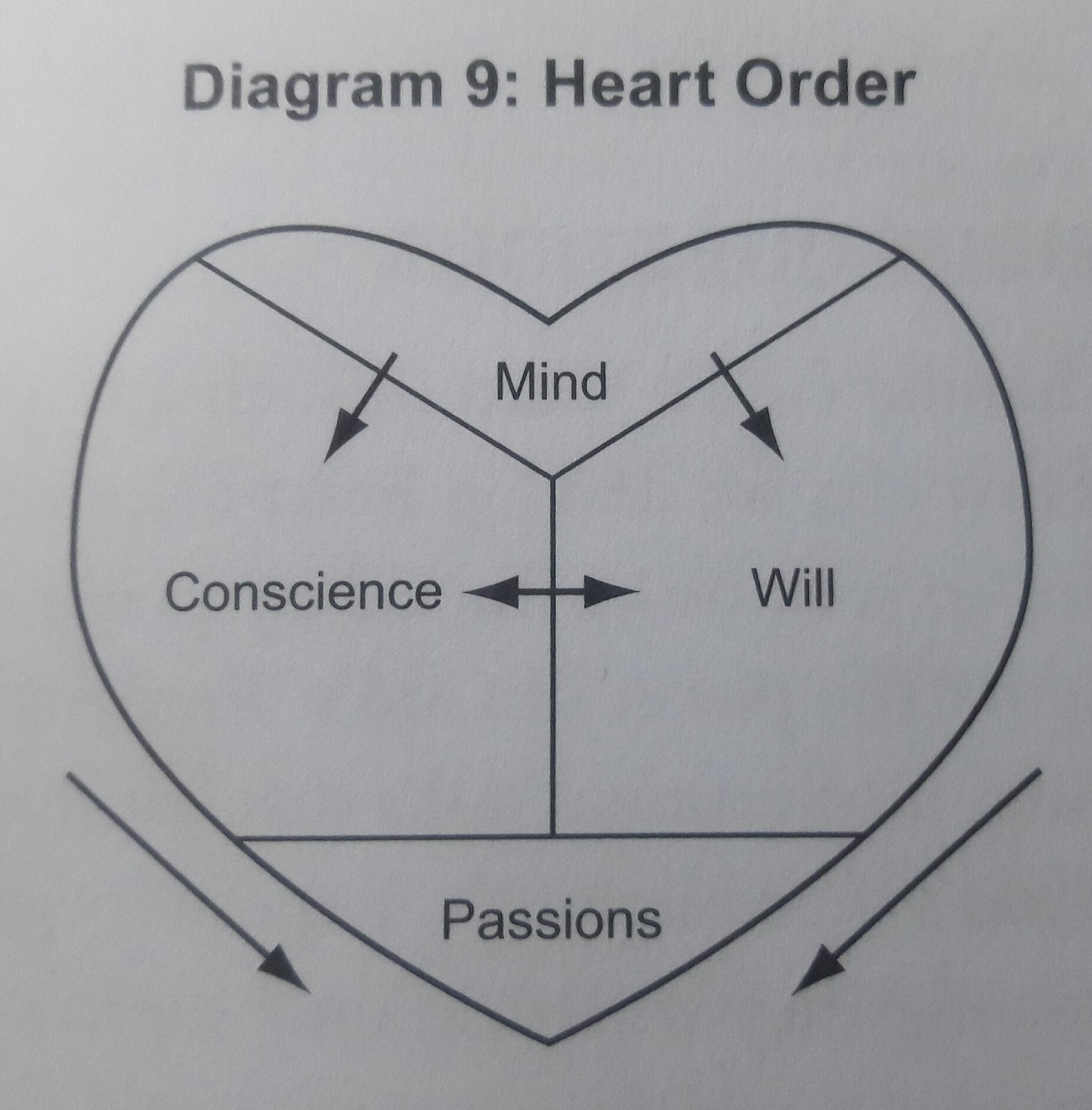
Like Green, 2 Timothy 3.16’s foursome provides a starting point (62-71). Then some lovely images. The chapter on the preacher’s life being a ‘reservoir’ for application and the need to keep filling that reservoir (81-95). The opening up of the biblical understanding of ‘the heart’ (which is so commonly misunderstood) and preaching towards what he calls ‘the faculties of the heart’: the mind, the conscience, the will, and the passions (97-129). At this point he uses a couple of his many simple diagrams (112, 113):

Another highlight for me was the chapter on “Preaching the ‘Ives'” – i.e. the role of the indicative, the imperative and the subjunctive in application (215-235). Like with Green’s book, the diagrams and the questions for reflection and discussion are there – but, with Capill, there are also examples of what he is articulating from his own preaching – as well as an Appendix that will make teachers of preaching salivate.
Bottom line? For anyone who preaches, Capill’s arrow needs to be part of the growth curve. For anyone involved in the training of preachers, I would add Green’s knife as well. A combo to appreciate.
nice chatting
Paul
About Me

the art of unpacking
After a childhood in India, a theological training in the USA and a pastoral ministry in Southland (New Zealand), I spent twenty years in theological education in New Zealand — first at Laidlaw College and then at Carey Baptist College, where I served as principal. In 2009 I began working with Langham Partnership and since 2013 I have been the Programme Director (Langham Preaching). Through it all I've cherished the experience of the 'gracious hand of God upon me' and I've relished the opportunity to 'unpack', or exegete, all that I encounter in my walk through life with Jesus.
Recent Posts


Football helps me train preachers. See, when you speak to me about football—or, ‘footie’—I need to know where your feet are before I can understand what you mean. Are your feet in Ireland, or Brazil, or the USA, or NZ—or in crazy Australia? It must be the most fanatical sporting nation in the world. Within…
Having been born in 1959, I don’t remember much about the 1960s. But I have heard a lot. Hippies. Drugs. Rock ‘n Roll. Assassinations. Moon-walking. A quick trip across to ChatGPT informs me immediately that it was ‘a transformative decade across the world’—marked by the civil rights and feminist movements, Cold War tensions, consumerism and…