Eighteen days in self-isolation at Little Huia. What a gift from God to us through our friends, Jan & Murray.
We chatted, with much to process after the quick exit from India.
Theology

If Shead is solid, then Hays is sparkling. Seriously, if you are someone who is either sceptical of the value of academic study or you are new to it and want to dip your toes into it, here is the place to commence your journey. It is so readable, so accessible. As I came to the ‘concluding reflections’ in each chapter, it was coming-to-the-boil so much inside me, that I had to lift off the lid … and so I read this section, each time, aloud to Barby. Alongside introductory chapters on the ethnic make-up of Old and New Testaments, Hays, like so many in the NSBT series, journeys his way through the Bible with his chapters: from Genesis 1-12, to Israel and the Law, to Israel and the monarchy, to the Prophets, to Luke-Acts and finally, to Paul and the Apocalypse. Along the way he keeps a particular focus on all the biblical references to the Cushites and then a particular application to his own context of the USA, with its well-documented struggle with racial issues (sadly, the book was written way back in 2003).
With Cush, we must not be fooled by the way translators of the Bible change the word (sometimes Ethiopia, sometimes Nubia) because all the words refer to “the same continuous civilization; a civilization that stood as one of the major powers in the Ancient Near East for over 2000 years; a civilization that appears again and again in the biblical text” (36) – and a civilization that is comprised, unequivocally, of ‘Black Africans’. They are there at the beginning (Genesis 10) and they will be there at the end (Revelation 5 & 7). In between we meet many ‘Black Africans’, or Cushites: Moses’ wife, Phinehas, a soldier in David’s army, Ebed-Melech (in Jer 38-39, ‘perhaps the most detailed and the most dramatic’ (130) of all the stories about Black Africans in the Old Testament), the Ethiopian eunuch, and Simeon called Niger. I’ve always argued that the best example of a topical sermon is the one that follows the biblical trajectory of a topic. Here is a place to start, with racism – remembering, always remembering, that “we must do racial equality and not just think racial equality” (172).
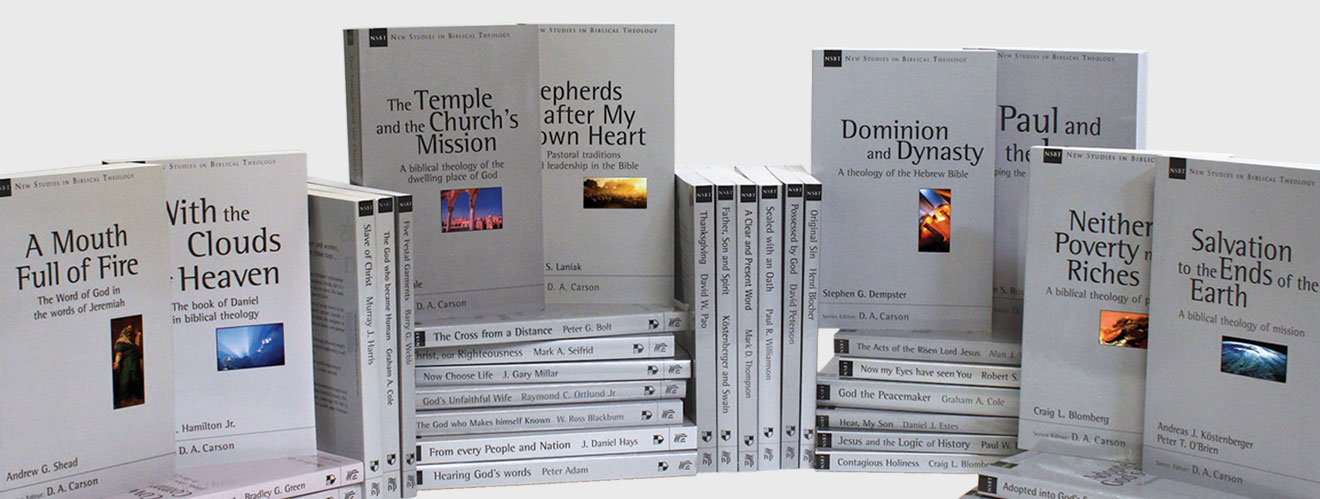 |
| For me, this series is the ultimate in reading theology – or, more specifically, biblical theology. I see them on my shelf … and I dream of taking a year off so I can binge my way through all of them. |
Preaching

There are ideas in Piper’s book to which I will return in my teaching: (a) his plea that preaching ‘press through texts into the reality being communicated’ (189) because a close observation/study of the text itself can only be the start and “we should show the hearers how we saw what we saw through the text … (as hearers) need wise, patient help to see and be amazed at what amazed you” (164, 171). (b) his material on ‘Christian eloquence’ (139-155), on urgency (243), on making ‘a beeline from the cross’ (234) not just a beeline to the cross, and his guidelines on preaching from the OT (280-303) will all be useful, as will his stunning description of the journey to the sermon in three paragraphs at the end (305-306, like ‘the pounding on the closed door of the text, until it cracks, and beams of light shine out’).
There are ideas in Stanley’s book to which I will return in my teaching. The first half of the book tells the imaginary story of Preacher Ray being airlifted into a ride with Truck-Driver Will, who is also a preacher. Using the metaphor of truck-driving, Ray is helped to imagine something beyond his current, impoverished preaching ministry. Seven areas emerge while in the truck with Will and then, Stanley zooms into each one of the seven, chapter-by-chapter, to give more specific guidelines for preaching. It is very well done. Stanley’s heart is not so much with “teaching the Bible, but teaching people the Bible” (48). Significant issues are covered: the move away from multiple points to a single point; the value of speaking without notes; the need to make connections with listeners (‘presentation trumps information when it comes to engaging the audience’, 146); the role of transitions; and finding your own voice. I can see myself incorporating his ‘map’ (ME-WE-GOD-YOU-ME, 119-130), alongside the Wesleyan quadrilateral, as a useful template for developing a topical sermon.
While I valued reading both books, I didn’t find either book totally convincing. I kept asking myself why this was the case because both Piper and Stanley have a massive following. I think the answer would emerge if I could do what I’d like to do – namely, put them in a room together for a day to listen and to learn from each other, with me listening-in and learning as well. They need each other. Piper’s thoughts are dense, his syntax complicated, and his prose unrelenting, while Stanley is such an easy-read, taking us on a rollicking ride through story and image, before offering a series of applicatory tips. Piper is so theological and philosophical by instinct that he can lose sight of the listener living in their world. Stanley is so anthropological and sociological by instinct that he can lose sight of the God revealed in the Bible with his own agenda. I finished Piper and was left floundering a bit with “So what? Now what? How?”. I finished Stanley and was left wondering a bit if there was much more than “So what? Now what? How?” As someone with a majority world context for ministry, I don’t see either of these books travelling well. Piper seems too dense and intense for simple, grassroots translation and Stanley seems too American with his metaphors and language. For many years now, rather than asking students for yet another boring book review, I’ve had them put two authors in conversation with each other. Maybe I have found another pair to use…

And so it came to pass that neither Christopher Ash’s Zeal without Burnout or David Murray’s Reset made it into my suitcase, as they were both awaiting my return to NZ! These are far shorter books, loaded with practical, realistic advice for managing self-care in 2020 … and written by authors willing to be transparent about their struggles.
Subtitles so often say it all. With Ash’s book, it is ‘seven keys to a lifelong ministry of sustainable sacrifice’. Hmmm … ‘sustainable sacrifice’ … I like it. In our cultures, so self-indulgent (this is one of my first impressions on returning to NZ, as I flicked through Nadia Lim’s magazine) and so leisure-focused, this sacrifice is a challenge. Maybe one value of this covidian world of ours is that it is causing us to confront these realities. Ash explores the possibility of sacrifice without burnout. Along the way I appreciated some reminders: (a) the importance of sustaining friendships, or ‘replenishing’ friendships as a counselor once put it to me; (b) the way ‘we are embodied beings’ (74) and so restoration needs to be as much physical and mental, as it is spiritual and emotional; and (c) the value of developing ‘a healthy self-knowledge about what energizes us’ (77) – and this is exactly why I keep chatting away to myself on this blog in the hope that it might serve some others who pass by. Such chatting, such serving, is what energizes me.
Subtitles so often say it all. With Murray’s book, it is ‘living a grace-paced life in a burnout culture’. I love the focus on grace because grace is not just amazing at the start, it is amazing all the way home. Murray opens with a reality check, with a spacious list of questions to ask ourselves (25-35); a review, with a useful focus on both ‘life situation’ and ‘lifestyle’ (44-51); and (c) a rest, with a fascinating discussion around sleep, even offering a few sleeping pills (53-70) … before setting off in pursuit of a few other words, beginning with ‘r’, as he plays with his master-metaphor (not so far away from Stanley’s truck-driving): taking the car into the garage with its various ‘repair bays’ in order to be fixed. [Sadly, and I am far from convinced with his reasons, Murray writes exclusively for males. I moaned about Crossway doing this just two months ago – and here, they are doing it again. Ugh!].
Oops, I had a binge with my reading and now I have had a binge with my writing.
Sorry about that … you’ve done well to get this far.
nice chatting
Paul
PS: The photo at the start is the remnants of a birdbath I gave to Barby on her 50th birthday. The bath broke somewhere along the way, while we were away – and all that is left is this elegant column with a koru on it. The koru, almost embryo-like in the way it depicts a fern all ready to unfurl, is an enduring Kiwi metaphor for the potential for growth, unfurling to become all that God designs us to be. And reading good books is a proven way to see the koru unfurled…
About Me

the art of unpacking
After a childhood in India, a theological training in the USA and a pastoral ministry in Southland (New Zealand), I spent twenty years in theological education in New Zealand — first at Laidlaw College and then at Carey Baptist College, where I served as principal. In 2009 I began working with Langham Partnership and since 2013 I have been the Programme Director (Langham Preaching). Through it all I've cherished the experience of the 'gracious hand of God upon me' and I've relished the opportunity to 'unpack', or exegete, all that I encounter in my walk through life with Jesus.
Recent Posts


Football helps me train preachers. See, when you speak to me about football—or, ‘footie’—I need to know where your feet are before I can understand what you mean. Are your feet in Ireland, or Brazil, or the USA, or NZ—or in crazy Australia? It must be the most fanatical sporting nation in the world. Within…
Having been born in 1959, I don’t remember much about the 1960s. But I have heard a lot. Hippies. Drugs. Rock ‘n Roll. Assassinations. Moon-walking. A quick trip across to ChatGPT informs me immediately that it was ‘a transformative decade across the world’—marked by the civil rights and feminist movements, Cold War tensions, consumerism and…