It is that time of the year when we in NZ are reminded of the scars of war.
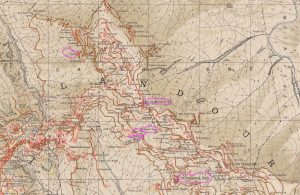
On Saturday we stopped in Tirau, on our way home from meeting our new grand-daughter, Eden. We were waiting for dumplings and bubble tea from a roadside food truck. Barby had popped into a craft fair in the War Memorial Hall and I was standing outside in the drizzle. My eye landed on this small display on the wall of the Hall:

It is very well done, isn’t it?
Gallipoli

This name is visible on that timeline… Here in NZ, we commemorate Anzac Day tomorrow—the anniversary of the landing in Gallipoli in World War 1. For this secular nation, Anzac Day seems to have an increasingly spiritual identity. While I don’t get into that aspect of it, there is no doubt about the legacy of trauma it left in many families—including my own whakapapa/heritage, as expressed in A Mother’s Poem. Every year, at this time, people find their way to this post…!
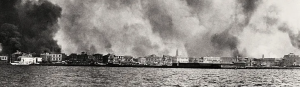
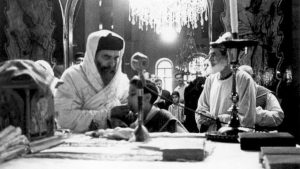
This photo is another heart-breaking image from that time.
Armenian Genocide
But there is another scar I try to remember. Just a few hours before the Gallipoli invasion, and only a couple of hundred miles away, was the start of the Armenian genocide. Historians are divided on whether there is a link between the two events. Although… the Armenian Christian identity did make them natural allies for the Russians, pressing in from the East, and now the British from the West. The centuries-old Ottoman Empire was already crumbling—and insecure. In that context, dealing to the Armenians has a certain logic about it…
Anyhow, I try to remember for two reasons.
(a) Given that my self-understanding starts with belonging to God and his family—with the ties that bind me to my nation being of secondary importance—I want to find ways to express a solidarity with other parts of the family of God. Armenia, ‘wedged between two pagan empires’, was ‘the world’s first nation to officially adopt Christianity’ (Bantu, 151). These Christian brothers and sisters are to be honoured for their endurance across many centuries and through many persecutions. This is why, if there is an Armenian church in the places to which I travel, I try to visit it (here and here).
(b) While I do understand some of the reasons—I feel embarrassed still that my country is not among those who officially recognise that the genocide took place. More recently, there is the silence in the face of the efforts being made to erase from history any Armenian presence in their historic homeland, as the writings of William Dalrymple have helped uncover.
Partition
Speaking of William Dalrymple reminds me of an initiative for which his son, Sam, is one of the founders. It deals with another scar from the twentieth century: Partition.
At home, the British were counting the cost of World War 2 and abroad, in India, they were watching the jewel in their empire descend into violence and anarchy. Louis Mountbatten decided to make an exit more quickly than was planned—and he brought in someone (Cyril ‘never been east of Paris’ Radcliffe) to draw the maps more quickly than was wise. Goodness me, the border wasn’t even announced until after Partition happened! And so, like in the Middle East a generation earlier, poor cartography led to a mess, the consequences of which are still with us today.
So this massive people movement takes place, flowing in both directions, with hundreds of thousands of Hindus moving to India and hundreds of thousands Muslims moving to the newly established country of Pakistan. One people become two peoples, with the suspicion and hostility deepening quickly. [NB: Barby’s parents had just arrived in India during this time, sheltering from the unrest for some days in a railway station]. It is so sad. I am an Indian lad (with 38% of life based there), but in these Langham years, I’ve just loved visiting Pakistan. Two peoples that are so similar—and yet so estranged.
The death toll at the time of Partition was horrendous (1 million)—but so also the separation toll ever since. The families caught up in it have rarely been able to go home and only recently have they begun telling their stories. Here is where Sam Dalrymple and his friends step into the story. They started Project Dastaan, an initiative which uses Virtual Reality technology to enable elderly people to visit their homes across the border.
It is astonishing.
Here is a taste, in 93 seconds…
Have a read of one of the stories, written up in a magazine, this time with a 205 second video.
And then, here are some pages from the website…


They are trying to make something beautiful out of these scars of war…
nice chatting
Paul
PS (1): I love the cricketing stories associated with Partition. Here is one example:
In this story it was the father (Master Aziz) who shifted to Pakistan, while the 12 year old son remained with relatives in India. The chapter title? “The Many Sons of Master Aziz” – because the father became a coach and ‘guiding light’ (33) for many of Pakistan’s finest players, even as his son ‘whom he adored and (had been) grooming to be a Test player’ (30) was lost to him back in India. Actually, ‘at his birth (this father) had passed a new cricket ball in front of his son’s eyes to get him used to the moving ball’ (32). ‘For the rest of his life, Master Aziz could not talk about his son without tears’ (31). He coached the five Mohammed brothers, four of whom played for Pakistan – while his own son did go on to play for India – Salim Durrani by name, ‘a flamboyant, crowd-pleasing all rounder’ (30).
…And more on Master Aziz? Not only did he never see his own son again, when one of his ‘many sons’ (Mushtaq Mohammed) led Pakistan to a victory over India in Karachi, ‘Master Aziz sat alone and unrecognised in the stands, eating an omelette wrapped in old newspaper’ (35).
[NB: This Salim Durrani died a few weeks ago… ]
PS (2): Here is another example:
One of the early captains of India, Lala Amarnath, was a Hindu from Lahore. He had to leave. In the very first Test between India and Pakistan, the two captains (Abdul Kardar and Amarnath) ‘would have understood each other very well’:
They had been brought up in the same city, played as boys on the same streets, represented the same clubs, and tested their skills against the same players. They spoke the same language, ate the same food, and wore the same clothes. But for accident of religion and history, Amarnath and Kardar would have been on the same side (70).
Years later (1978), when Amarnath returned to Pakistan with the Indian team as a commentator, a Mercedes was waiting at the Lahore airport. The manager of the Indian team thought it was for him – but, no, it was for ‘Lala-sahib’ – being welcomed back to his home town. Still today, at a national level there is conflict and tension across the border – but at a personal level there can be real affection.
[NB: This Lala Amarnath was played by his son, Mohinder, in 83—a movie about India winning the Cricket World Cup. Mohinder himself was one of the stars of the team, but was played by someone else obviously…].
PS (3): Oh yes, here I am with my new grand-daughter, Eden 😀 …

About Me

the art of unpacking
After a childhood in India, a theological training in the USA and a pastoral ministry in Southland (New Zealand), I spent twenty years in theological education in New Zealand — first at Laidlaw College and then at Carey Baptist College, where I served as principal. In 2009 I began working with Langham Partnership and since 2013 I have been the Programme Director (Langham Preaching). Through it all I've cherished the experience of the 'gracious hand of God upon me' and I've relished the opportunity to 'unpack', or exegete, all that I encounter in my walk through life with Jesus.
Recent Posts

Football helps me train preachers. See, when you speak to me about football—or, ‘footie’—I need to know where your feet are before I can understand what you mean. Are your feet in Ireland, or Brazil, or the USA, or NZ—or in crazy Australia? It must be the most fanatical sporting nation in the world. Within…
Having been born in 1959, I don’t remember much about the 1960s. But I have heard a lot. Hippies. Drugs. Rock ‘n Roll. Assassinations. Moon-walking. A quick trip across to ChatGPT informs me immediately that it was ‘a transformative decade across the world’—marked by the civil rights and feminist movements, Cold War tensions, consumerism and…