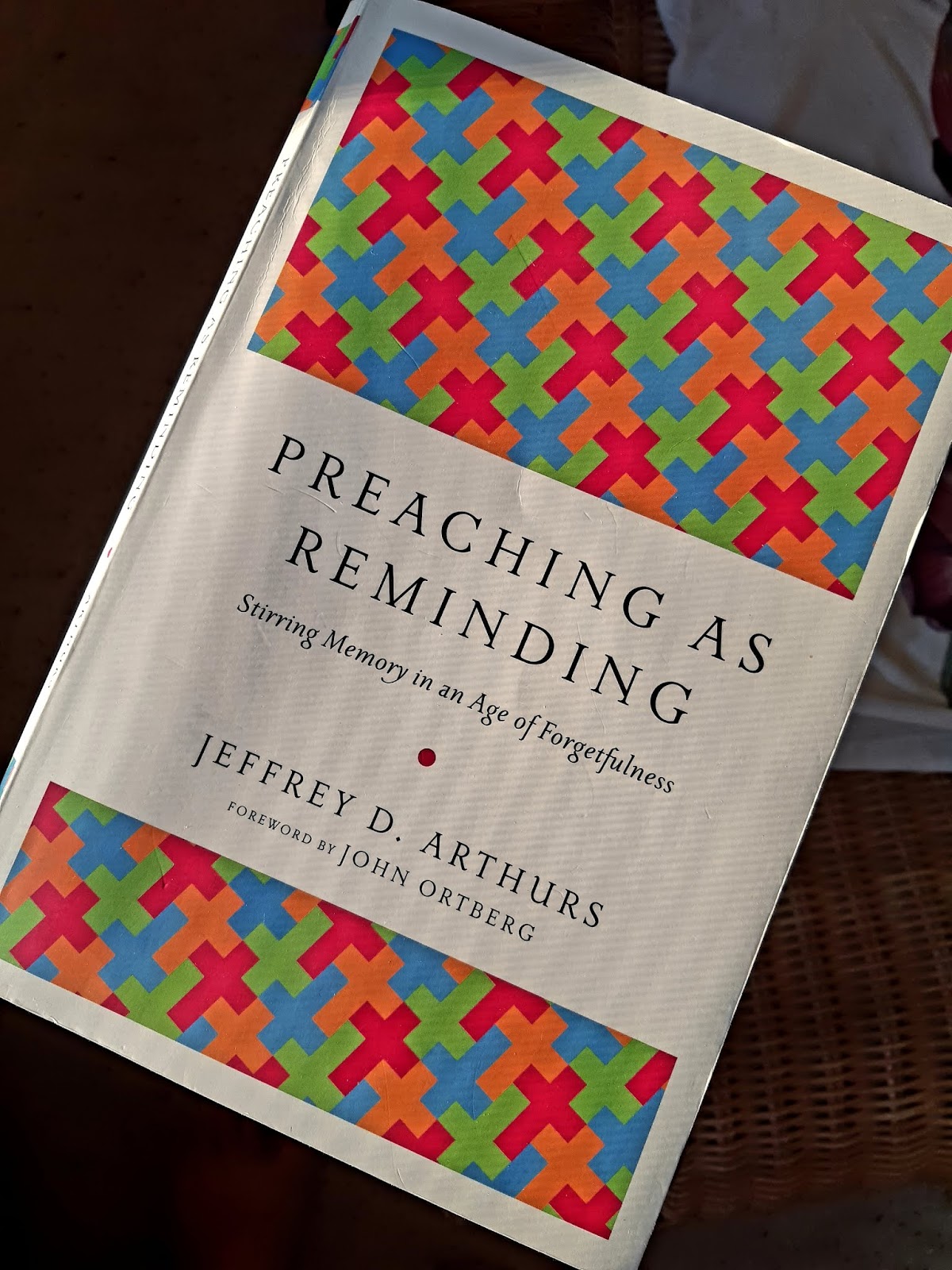
So it has been for me with the author, Jeffrey Arthurs. His book on preaching from different biblical genre is the best entry point into that fascinating field of which I am aware. So when Preaching as Reminding (IVP, 2017) emerged, it went straight onto my little list for purchase and consumption. For years, my hunch has been that the rush to ‘forget the former things’ is a little hurried and is applied in a way that is not totally justified, biblically. So, what about remembering…?
‘One of the most crucial functions preaching accomplishes, a function often neglected in homiletics textbooks, is the stirring of memory’ (4). Reminding prompts thanksgiving, raises hope, prompts repentance, fosters humility, helps believers walk wisely, warns of unbelief and disobedience, encourages belief and obedience, prompts mercy, and forms individual and communal identity (7-8).
The book falls into two parts. The first is around the God who remembers and the people who forget, drawing on material from the Bible and places like neuroscience. ‘Electronic media are making us adept at skimming and inept at exegeting … (new) technologies tend to create minds that have trouble holding still’ (36-37). One delightful little chapter, likely to emerge onto ‘required reading’ lists for me, is ‘The Lord’s Remembrancers’ (47-64) where Arthurs gathers together the biblical witness to reminding: Moses, prophets and apostles.
However it is the second part of the book which I find even more useful. The four different ways to stir memory: style, story, delivery, and ceremony/symbol. Each one receives its own chapter and each chapter has the same structure: “How It Works” and “How to Work it”. So clear and practical – it is an exceptional collection of chapters.

Style is about the use of words. Things like concrete language. ‘The key … lies in the verbs and nouns. That is where the action of the sentence struts … a lean style sparks imagination better than a verbose style’ (73). As I’ve said to students over the years, “Think twice – no, think a third time – before you use an adjective or an adverb. Select a stronger noun or verb instead.” Things like metaphor, so common in the Bible and so ‘generative – it gives birth to ideas and emotions not commonly experienced when we use literal language’ (75). Things like repetition and rhythm. ‘Oral style is not written style … Eloquence soars on the wings of repetition and rhythm’ (78, 80). Yet another chorus from my classes comes to mind: “Listeners cannot re-listen like readers can re-read – so repeat.”
Story is about … story! ‘How it works’ (imagination and emotion; clarification by articulation; identification and community; and indirection) – but also ‘How to work it’ (retell Bible stories; use dramatization – ‘show the truth’ (96); use testimony – that ‘narration of events paired with a confession of belief’ (98); and use stories from history).
Delivery is ‘what we sound like and look like when we speak (104).’ Kinda like the music and the video, rather than the lyrics, is how I’ve tried to explain it to students. It is the non-verbal and it is often ‘neglected’ (104). The issues cause some discomfort for the preacher, as seen in Arthurs’ affirmations: (a) ‘when the nonverbal message conflicts with the verbal, listeners trust the nonverbal’ (109) – yikes?!; (b) ‘the nonverbal channel is the primary conveyer of relationship and emotion’ (110) – and it all happens so quickly, within seconds; (c) ‘nonverbal behavior generates emotion in the sender’ (112); and, (d) ‘the speaker’s delivery prompts a reciprocal response in the listener’ (113) – ‘as when a mother smiles at her baby and the baby smiles back’ (113). I found this next section on how to develop in delivery (115-124) to be so helpful. It is hard to do this stuff ‘in print’ – but Arthurs captures a bunch of ideas and exercises and checklists that I suspect will become a starting point for preachers and their teachers. ‘Start with yourself … Once the foundation of a vibrant devotional life is in place, we can build with techniques to construct solid delivery’ (116, 118). Never thought of it like that before. ‘Watch yourself on video’ (119) – with a checklist provided. ‘Get your body and voice involved’ (122) – with a series of suggested exercises.
Ceremony and symbol, or ‘the liturgical arts – to keep the truth warm in heart and mind’ (126). Things like sacred spaces (for example, the building of altars in the book of Genesis); ‘sacred time – the liturgical year was used as a reminder of salvation history, not simply marking the calendar’ (127); rituals; public reading of scripture; and music – which’opens the heart like nothing else’ (130). Once again, when it comes to the ‘how to work it’ part of the chapter, Arthurs is so helpful. Be it a checklist to test whether ‘your rituals have meaning’ (135); or, his pondering that ‘the higher the view of Scripture, the lower the practice of reading it aloud’ (137); or, specific ways to improve the opening and closing words in a worship service; or, suggestions for the celebration of the Lord’s Supper and the practice of baptism; or, finally, assisting our public prayers to become better ‘remembrancers’.
May I conclude with how Arthurs’ concludes?
St. Mungo founded the city of Glasgow, Scotland, in the late sixth century. A line from one of his sermons became the unofficial motto of the city and was inscribed on the bell of the historic Tron Church in 1631: “Let Glasgow flourish by the preaching of thy word and the praise of thy people.” In 1866 a shortened secular version became the official motto and today adorns the city’s coat of arms: “Let Glasgow Flourish.” Visit Scotland’s largest metropolis and you will see that motto on buildings, lampposts, clock towers, gates, even rubbish bins. The modern motto expresses a wish that is positive and hopeful yet a bit vacuous. The older motto grounds the hope of flourishing in the means of flourishing – robust preaching and worship. (147)
nice chatting
Paul
About Me

the art of unpacking
After a childhood in India, a theological training in the USA and a pastoral ministry in Southland (New Zealand), I spent twenty years in theological education in New Zealand — first at Laidlaw College and then at Carey Baptist College, where I served as principal. In 2009 I began working with Langham Partnership and since 2013 I have been the Programme Director (Langham Preaching). Through it all I've cherished the experience of the 'gracious hand of God upon me' and I've relished the opportunity to 'unpack', or exegete, all that I encounter in my walk through life with Jesus.
Recent Posts


Football helps me train preachers. See, when you speak to me about football—or, ‘footie’—I need to know where your feet are before I can understand what you mean. Are your feet in Ireland, or Brazil, or the USA, or NZ—or in crazy Australia? It must be the most fanatical sporting nation in the world. Within…
Having been born in 1959, I don’t remember much about the 1960s. But I have heard a lot. Hippies. Drugs. Rock ‘n Roll. Assassinations. Moon-walking. A quick trip across to ChatGPT informs me immediately that it was ‘a transformative decade across the world’—marked by the civil rights and feminist movements, Cold War tensions, consumerism and…



v interesting – just ordered – seems to develop one of the things I tried to pick out a bit in my Covenant lectures in 2017… it looks fab
It is kinda odd. The stuff in the book that maybe I appreciate the most doesn't not seem to have much to do (on the surface) with 'reminding'. There is a lot more to it than meets the eye in that title.