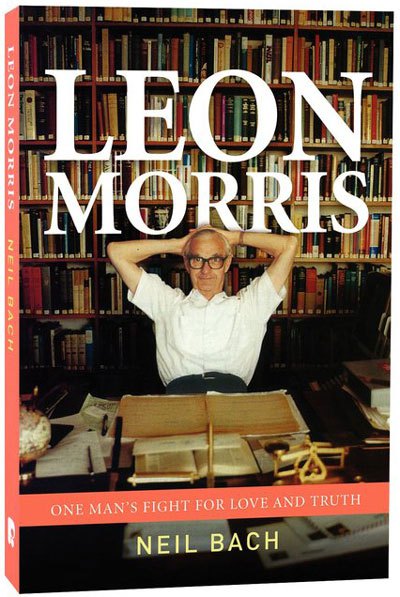
Within weeks of starting my theological training, DA Carson was making sure we knew about Leon Morris. I was just 21 years of age. First impressions tend to linger. Two of the first books which I purchased as a student were The Apostolic Preaching of the Cross and The Gospel According to John.
Leon Morris is arguably the most influential biblical scholar to emerge from Australia-New Zealand – ever. Not sure why I add ‘arguably’ – because who else could there possibly be?! [NB: If you are up for it, an old series of Leon Morris sermons from John’s Gospel available here]. Anyhow – when Neil Bach’s Leon Morris: One Man’s Fight for Love and Truth emerged last year, I was all over it. Here are some of the random reflections that impacted me:
Leon Morris was a shy lad from a rural mining town in Australia. He had a bit of a speech impediment and an accident left him visually impaired – basically, blind in one eye. ‘He did not have a strong need to be known’ (xiii). Shining through his life for me is what God can do with a consecrated life that is willing to empty itself.
The subtitle usually captures it: ‘one man’s fight for love and truth’. If his life had a thesis statement it would be ‘a ‘passion for the love of God seen in the truth of Christ’s cross’ (3). Love. Truth. Not an easy tension to maintain. My mind drifted across to John Stott’s analysis of the greatest crisis the church has ever faced (as described in Acts 15). The outcome? Love triumphed. Truth triumphed. So crucial for the church when drawn into conflict. 1 John is a book that holds these two together well – and because of this I have often urged new pastors to preach through first John in their first year.
On completion of his training, Leon Morris ‘wanted to go to a remote area to serve God’ (24). And so it was to be: five years pastoring clusters of people in the Australian outback. I remember benefiting from a similar experience, with five years in Invercargill. It gives you an opportunity to sort yourself out in leadership and ministry without the clutter, the distractions, and the competitions which urban life so easily fosters.
A distinctive of his scholarship was that he took the text seriously. His landmark book on the atonement (see above) overturned the accepted consensus, causing ‘a shift in theological history’ (4). He helped people ‘to think clearly and use words carefully’ (187). The mark of his teaching was his ability ‘to be clear, using simple language to explain complexities without losing depth’ (43). He was ‘compelled to write by an inner drive to faithfully record his findings’ (74). According to Carson, Morris ‘demonstrated a knack for addressing a fad’ (128) which is just how scholarship needs to be used in the church today. His practise was to write ‘one page a day for publishers when at home’ (219) which, at six days a week, amounts to 300 pages each year. In the author’s estimation more than two million copies of books by Leon Morris have been published – and, remember, these are basically scholarly books…
Given the company he kept, I was surprised at Morris’ perspectives on two vexed issues of the past generation or two: the authority of scripture and women in ministry. He was more spacious than I expected. On the former, he held some of the the heated inerrancy debate at arm’s length, preferring to speak in terms of authority and inspiration. On the latter he considered that ‘more than one conclusion could be drawn from the scriptural evidence’ (180) – and this from someone who was as careful and as evenhanded as anyone has been with the biblical text.
He saw enough evidence of the treatment and inclusion of women in ministry in the New Testament, against the culture of the first century, to be satisfied he could be a gentle supporter of women in ministry (182).
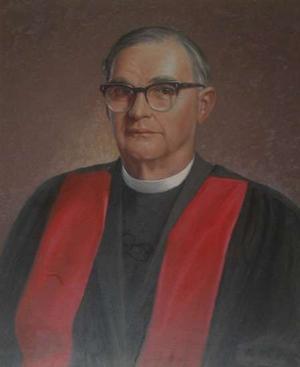
If Leon Morris has a career-defining role, it was his 15 years as principal of Ridley College in Melbourne. This was an absorbing part of the story, mostly because it had its difficulties and the author is willing to expose some of this reality. It seems that Morris would have welcomed, even expected, the opportunity to be principal earlier than it eventuated. When the invitation did come, he was pretty grumpy – ‘I could wish that the Council in its wisdom would go jump in the Yarra’ (112). At the time he was Warden of Tyndale House (Cambridge) and loving it – and he had also received an invitation to join the faculty at TEDS in Chicago. In order of preference, he felt suited to Tyndale House, then TEDS, then Ridley … but, together with Mildred, they heard ‘the increased sense of God’s call (to Ridley) against their personal preferences‘ (121, emphasis mine). What a testimony!
Ridley experienced ‘six successive years of record student enrolments’ under Morris’ leadership – as the college ‘remained true to evangelicalism in a pluralistic diocese’ (185). But he struggles as a leader. ‘Leon could not let go (of administrative tasks) … he did not always welcome the initiative of others … while he encouraged people, he was not an effusive employer’ (163). His legacy in leadership was a bit too much ‘the benevolent superman’ (164). However, it is interesting that the author notes that ‘no principal of Ridley since the 1940s has found the job easy, given its in-built tensions and responsibilities’ (163).
After Leon Morris retired, Peter Adam, one of his former students and a future Ridley principal himself, visited him and Mildred and on asking about his time as principal, received ‘a twenty minute tirade on how difficult they had found their time at Ridley’ (188). It is an astonishing paragraph for the author to include. I read it twice to make sure I’d got it right. Far too honest for most published biographies of this type, but I found it added an integrity to the other 300 pages! I’ve been a principal of a similar college with similar issues for a similar period of time and, in such leadership, as Peter Adam himself concludes, ‘the inside story was quite different’ (188).
As a young pastor I tried to read one biography of a saint every year. It was a way to warm the heart, renew the convictions and re-center the dreams and goals. While I’ve drifted from this practise, I am pleased that I’ve started 2017 by doing so…
nice chatting
Paul
About Me

the art of unpacking
After a childhood in India, a theological training in the USA and a pastoral ministry in Southland (New Zealand), I spent twenty years in theological education in New Zealand — first at Laidlaw College and then at Carey Baptist College, where I served as principal. In 2009 I began working with Langham Partnership and since 2013 I have been the Programme Director (Langham Preaching). Through it all I've cherished the experience of the 'gracious hand of God upon me' and I've relished the opportunity to 'unpack', or exegete, all that I encounter in my walk through life with Jesus.
Recent Posts
Football helps me train preachers. See, when you speak to me about football—or, ‘footie’—I need to know where your feet are before I can understand what you mean. Are your feet in Ireland, or Brazil, or the USA, or NZ—or in crazy Australia? It must be the most fanatical sporting nation in the world. Within…
Having been born in 1959, I don’t remember much about the 1960s. But I have heard a lot. Hippies. Drugs. Rock ‘n Roll. Assassinations. Moon-walking. A quick trip across to ChatGPT informs me immediately that it was ‘a transformative decade across the world’—marked by the civil rights and feminist movements, Cold War tensions, consumerism and…


Thanks for posting this Paul – I bought this for my dad for Christmas & he enjoyed it. I need to get a copy for myself now 🙂 I've enjoyed Morris' work through the years, particularly 'The Atonement'.
Having re-read Sanders' Spiritual Leadership, I managed to find a copy of a v simple biog of him – am currently enjoying that & the delights of the man from Invercargill…on the other hand, I'm also reading a biog of Sir Marcus Loane, which is interesting & occasionally insightful too. I've always loved biography – what next for you?
Not sure about the next biography, Ben. What do you suggest? My sister recently challenged me to do something I enjoy, something replenishing, every day. Biographies are right up there. Ahh – JO Sanders. I've got a few stories on him. It is he who urged me, as a 29 year old pastor in Invercargill, that 'it was time to paint on a broader canvas'. Well…
Just looking at my shelves (most of my books remain in the UK 🙁 ) – I enjoyed Francis Schaeffer by Colin Duriez (IVP), also enjoyed Duncan Hamilton's reflections on Eric Liddell in 'For the Glory' (DH isn't a Christian, but is very fair & warm to his subject). Much, much simpler, but energetic & infectious is Michael Green's 'Compelled by Joy', which as an evangelist I appreciated.
Really enjoyed the JOS book – wow, he seemed a lovely, godly man. That canvas is being broadly painted now, eh?! Would love to chat more of him some time.
Literally just finished reading this myself now – and felt compelled to write immediately on your blog. Wow – loved this biography. I came away wishing I'd known him & wowed by his obvious love for the cross and all it has accomplished & means for us as believers.
I too was surprised by his views on women in ministry & also his articulation of the inerrancy debate, but felt both enhanced his reputation. I loved that final comment "Despite all his fame, achievements & publishing success, he never forgot that he had been died for by Christ on a cross." It's a great read & one I'll be recommending to others.