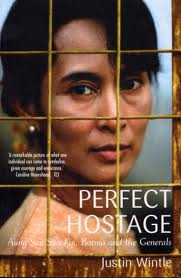
I started with Justin Wintle’s book, Perfect Hostage, picked up at the bookshop in the departure area of Phnom Penh airport.
Given the recent developments in the story, it is a bit dated (2007). However I found it valuable to begin my pilgrimage with a book written in the midst of the long season of hopelessness. Plus one third of the book is devoted to the history of Burma which recent events will not change – and which provide the all-important context for them.
Burma is not an easy part of the world for a mother-tongue English-speaker like me – with its names and places and acronyms being so foreign to me – and so the glossaries were indispensable.
The book just made me hungry for so much more. It gave me the pre-understanding that helped me savour the superb 60 minute BBC documentary, The Choice (2012).
I also watched the movie, The Lady – available at your local video store and also serialised on you-tube in fifteen sections. Then I spent ages browsing you-tube clips, particularly some of the historical material. This little one (see below) is my favourite. It is 2 minutes of real footage from 1996 of Suu Kyi doing what she used to do when her house arrest loosened-up a bit – stand on a table at the gate of her house and speak to those who gathered.
How would I sum up what I have learned?
Aung San Suu Kyi is more impressive than I had realised. Let me draw together a few threads, with a focus on the book, in particular.
1. The sadness in the story
The emotion tugs away at the heart as you read and watch. ‘Above’ her, generationally-speaking, is her father who is also the father of modern Burma, Aung San. At just 32 years of age (with Suu Kyi 2 years old), he was assassinated, together with his cabinet. The brother with whom she was so close drowned in the pond behind their home as a young boy. The brother with whom she was to become estranged remains far from her story. Her husband alongside, Michael Aris, is an unheralded hero in it all – and he dies of cancer while they are forced apart by her years of house arrest in Burma. And then her own boys – what a tough life for them!
Her mother became the Burmese Ambassador to India and so in her teens Suu Kyi moved to Delhi – just like I did :). I kinda like that symmetry. (I am actually in Delhi as I write). It was her dedication to her mum that drew her back to Burma when she became ill, a decision which eventually snookered her into her life’s purpose. Also interesting that she had an ‘adored and adoring Christian grandfather’ (154).
2. The place in history
There is more than a hint both of Gandhi’s commitment to non-violence and Mandela’s willingness to collaborate with the enemy. For me, Suu Kyi sits there right alongside both of them. Throw in Martin Luther King too. She was adamant. ‘Any victory gained by violence could only perpetuate the violence’ (283). [Gee – that is such a long way from the NRA’s ‘only way to beat a bad guy with a gun is with a good guy with a gun’, in the wake of the Sandy Hook violence].
The book finishes with talk about ‘the triumph of failure’ (429). It is not the only place where the biblical resonance was felt. What has become of our theology of failure? In the very final paragraph – written in 2007 – the hope is expressed that ‘future Burmese history books may one day enshrine her name, and not the names of Burma’s brutally vainglorious generals’ (436). In 2013, that future hope seems closer to being realised.
3. The example in leadership
It is case-study material. This is character-driven leadership in evidence. A life of sacrifice and simplicity. Strong and serene. Aristotle’s logos-ethos-pathos comes to mind, as word and life and passion are in such concert together with her. She dwarfs the examples used by Jim Collins to support his profound Good to Great thesis: the enduringly effective leader is marked by personal humility and stubborn resilience. When the Nobel Peace Prize was given, one citation noted the ‘extraordinary combination of sober realism and visionary idealism’ (352).
Suu Kyi’s first speech in public was in front of tens of thousands of people. Imagine that…
Suu Kyi’s life is so contrary to the cult of the ‘Big Man’ which terrorises and subverts leadership all around the world, not just in the state – but let’s face it, in the church as well. The words may say otherwise but the life speaks clearly about who the Big Man is. It is one of the reasons why leadership needs to be conducted through teams made in the image of the trinity and in the spirit of the servant Jesus. Leaders need to learn how to relinquish power, in the big and the small things. If they don’t, then the spirit of the Burmese generals hovers, as ‘ultimate power induced ultimate paranoia’ (272).
There is Suu Kyi’s courage, staring down the army loaded with guns at Danubyu (308-316) which, together with the narrative of the Inya Lake massacre (239-248), are two of the most gripping parts of the book. The Lady does not convey this repression enough. Maybe they were wanting to keep the movie ‘PG’?
There is Suu Kyi’s patience. One of the phrases that jumped out for me was ‘she bided her time’ (247). The biding is still happening… The repressive rule has lasted 50 years and it will take extraordinary patience to see the end of it. She demonstrates it. The hunger strikes. In one stand-off with the army, ‘she remained in her car for nine days, refusing to turn back’ (401). Do courage and patience receive enough focus in the conversation about leadership today?
There was a reluctance about her assumption of leadership. As JO Sanders once noted, the best leaders often have this reluctance about them. They do not waltz their way into leadership. They have to be persuaded – and called. As Suu Kyi sat caring for her mother in hospital, watching brutalised students fill the beds nearby, the persuasion of their leaders ripened into her call. ‘The simple indomitable fact of who Suu Kyi’s father was, or had been … (it was) his ghost calling her back to redress the archaic and anarchic world of Burmese politics’ (208).
Just one more telling sentence on this topic. ‘Suu Kyi had the gift of giving someone her undivided attention, identifying their core concerns, and then satisfying them with her answers’ (290).
4. The investment in students
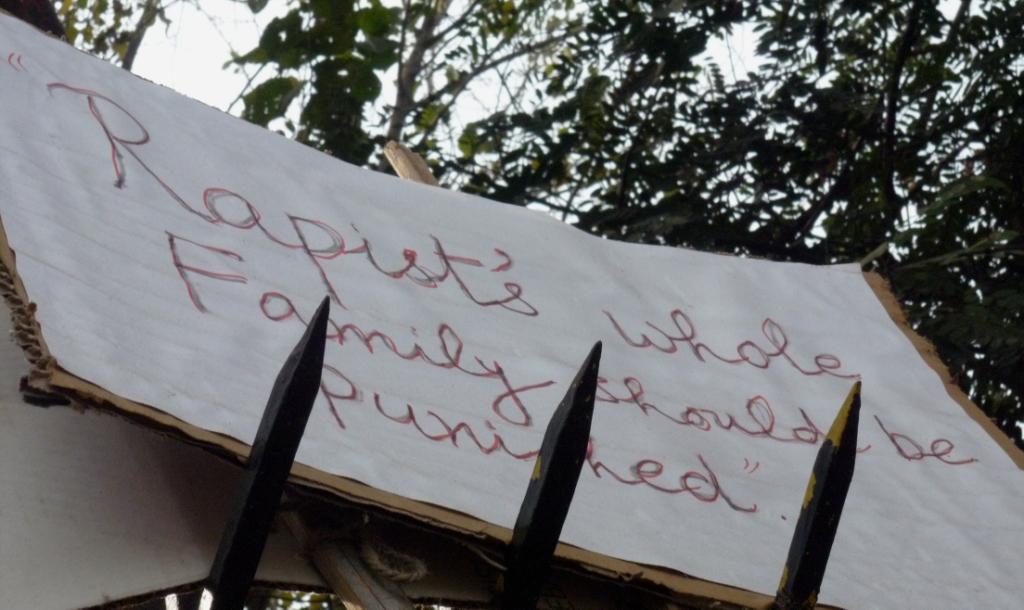
Like so many stories of change, students play their role. I hope it is happening here in India at the moment. That awful rape that has gone around the world (and the subsequent death of the woman) took place just ten minutes up the road. And who is the most angry? The politicians? No – it is the students who are flooding the streets with their anger.
With Suu Kyi, there was time for the students. Powerless, poor and without influence. Yet she believed in them. She listened to them. In the early days, she even followed them. They urged her into leadership. She trusted the young ‘because they had no hidden agenda’ (308). They were her bodyguards. They suffered together. They died for her. It has been said that ‘the decision every ambitious Burmese must make is not whether to betray his leader, but when’ (77). It is hard to imagine that to be true in the relationship between Suu Kyi and those students alongside whom she stood. Maybe it is only true for the truly ambitious?
5. The complexity of Burma
Later this month, it will be my privilege to be in Burma. The book gave me new insights – especially in the area of ‘Burma’s ethnic congestion’ (20). There is such a long and difficult history here. Under repression everything was squashed – but now, as things are loosening this is surfacing again. Be it with the Christian Karen, the Muslim Rohingya … or whoever – there are massive challenges. It is going to take a very special leader to pull this country together. I wonder who might be up to the task?
nice chatting
Paul
About Me

the art of unpacking
After a childhood in India, a theological training in the USA and a pastoral ministry in Southland (New Zealand), I spent twenty years in theological education in New Zealand — first at Laidlaw College and then at Carey Baptist College, where I served as principal. In 2009 I began working with Langham Partnership and since 2013 I have been the Programme Director (Langham Preaching). Through it all I've cherished the experience of the 'gracious hand of God upon me' and I've relished the opportunity to 'unpack', or exegete, all that I encounter in my walk through life with Jesus.
Recent Posts
Football helps me train preachers. See, when you speak to me about football—or, ‘footie’—I need to know where your feet are before I can understand what you mean. Are your feet in Ireland, or Brazil, or the USA, or NZ—or in crazy Australia? It must be the most fanatical sporting nation in the world. Within…
Having been born in 1959, I don’t remember much about the 1960s. But I have heard a lot. Hippies. Drugs. Rock ‘n Roll. Assassinations. Moon-walking. A quick trip across to ChatGPT informs me immediately that it was ‘a transformative decade across the world’—marked by the civil rights and feminist movements, Cold War tensions, consumerism and…